The generational Dean Thiessen Stranger Friends Orchestra
Beyond just their recent Fox Cabaret show, the band is a social beacon for my generation

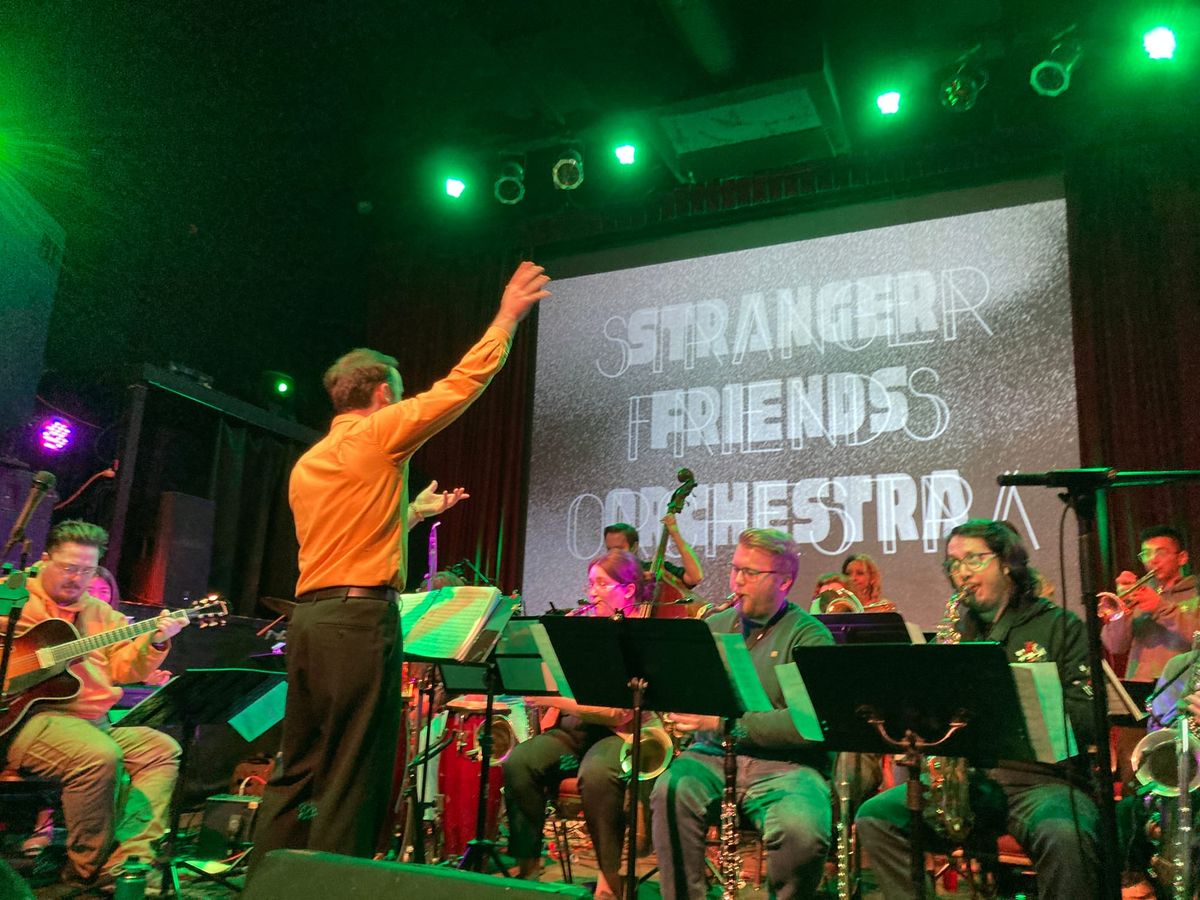
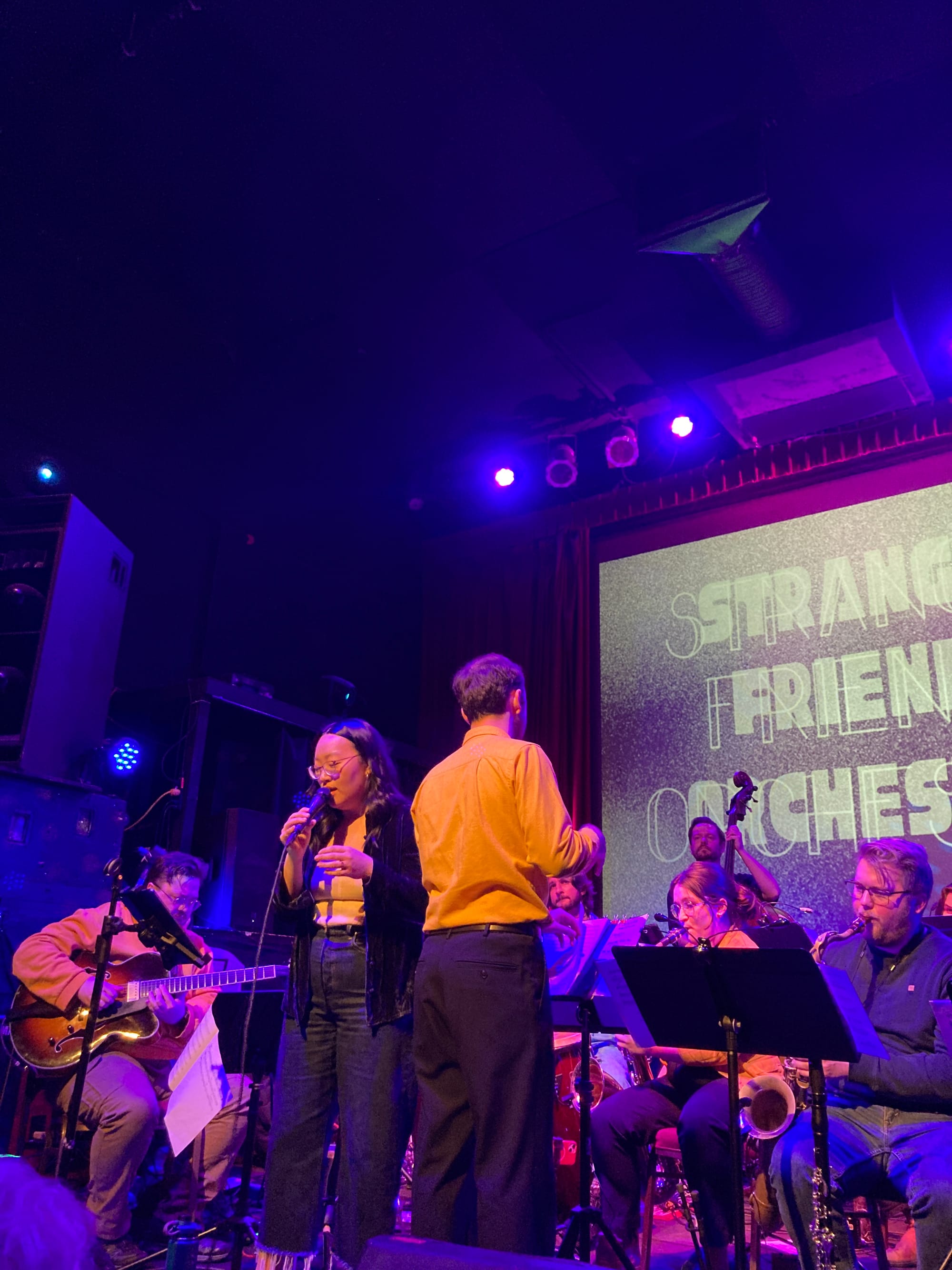
Dean Thiessen's Stranger Friends Orchestra played the Fox Cabaret on March 8, 2024. A successor to their well-loved outdoor jazzfest set at the art gallery stage last summer, this show featured a packed house and loud, warm original compositions – plus two Joni Mitchell songs, sung by Dean's wife Cindy Dai-Thiessen.
I'm not afraid to compare Dean's large-ensemble work with two of his major influences, Hugh Fraser's VEJI and John Korsrud's Hard Rubber Orchestra; to me he holds the torch high as the next artist in that lineage.
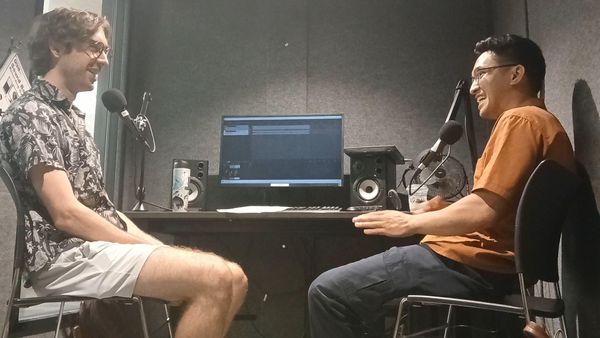
Dean joined me for an interview shortly after the show, while its afterglow was still burning. I asked a few quick questions to let him expand on how it had settled in his memory. I'll also share some of my thoughts below after that.
WILL CHERNOFF: Who played lead trumpet?
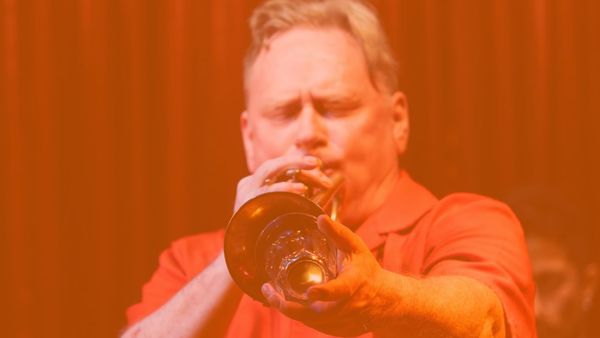
DEAN THIESSEN: Rory Hislop played first through the whole show. First trumpet is a pretty demanding role in any big band, and Rory plays that role so well. I think playing first trumpet is not an easy role to switch on and off of. Like a marathon runner, Rory is in that zone for the whole show, and it’s best to leave him there.
Feven Kidane and Thad Bailey-Mai switch second and third depending on solos, and on how I imagine the trumpet section blending from one tune to the next. Or they just switch without telling me!
WC: How did you end up choosing to do the Joni Mitchell songs, or those songs of hers in particular?
DT: Running a big band is about so many wonderful things: musical expression, spontaneity, and creativity, to name a few. But it also requires some pretty disciplined efficiency, because [wasted] time gets quickly multiplied by 15.
So to answer your question, efficiency. "Help Me" was the arrangement I wrote for my final [project] for Bill Coon’s big band arranging course in 2016 at Capilano University. My arrangement is originally based on Tilden Webb’s arrangement, shown to me in 2015 by bassist Aaron Andrada. And "Both Sides Now" was Cindy's final [project] for the same class a year later.
Both of the arrangements were only about a minute-and-a-half to two minutes long at first, so I had a lot of fun ripping them up, tearing them apart, and then putting them back together into the versions you heard at the show. These two pieces jumped out at Cindy and I as something really special eight years ago, and they felt like the perfect fit for this program too.
WC: To what extent do you write for the particular people in the band?
DT: I mean, that's what it's all about. That is what takes it from being just a bunch of charts to being a real band. Most of the charts have the players' names written on them, or printed under the instrument name in the top left corner.
I think the difference between writing for a big band and writing for this big band has been [that] conscious decision, and I try to let it influence my choices constantly. And I think the band members can tell. As the band continues to play, and I learn more about the musicians' strengths individually and collectively, the band will just feel more and more natural.
WC: How do you feel now that the show is complete and by all accounts a success?
DT: I feel amazing. It's been a bit of a roller coaster these past couple weeks: I found out that our Canada Council for the Arts grant [application] to produce a full-length record was unsuccessful, which was pretty disappointing. But this show was a very obvious reminder that this band is something really unique and special, and I'm just going to keep going with it.
This music is written with a purpose of bringing people together into a collective experience, and I believe it did just that. I learned a lot through working on this show. It will just make the next one and all future projects that much better.
And of course, I feel huge gratitude towards every member of this band. They are truly dear friends who have given me so much of their time and energy in rehearsals, their own practice time, and in replying to my many, many messages. I'm grateful to have a career that is so dependent on having good relationships with my peers.
Here are my own thoughts on the night:
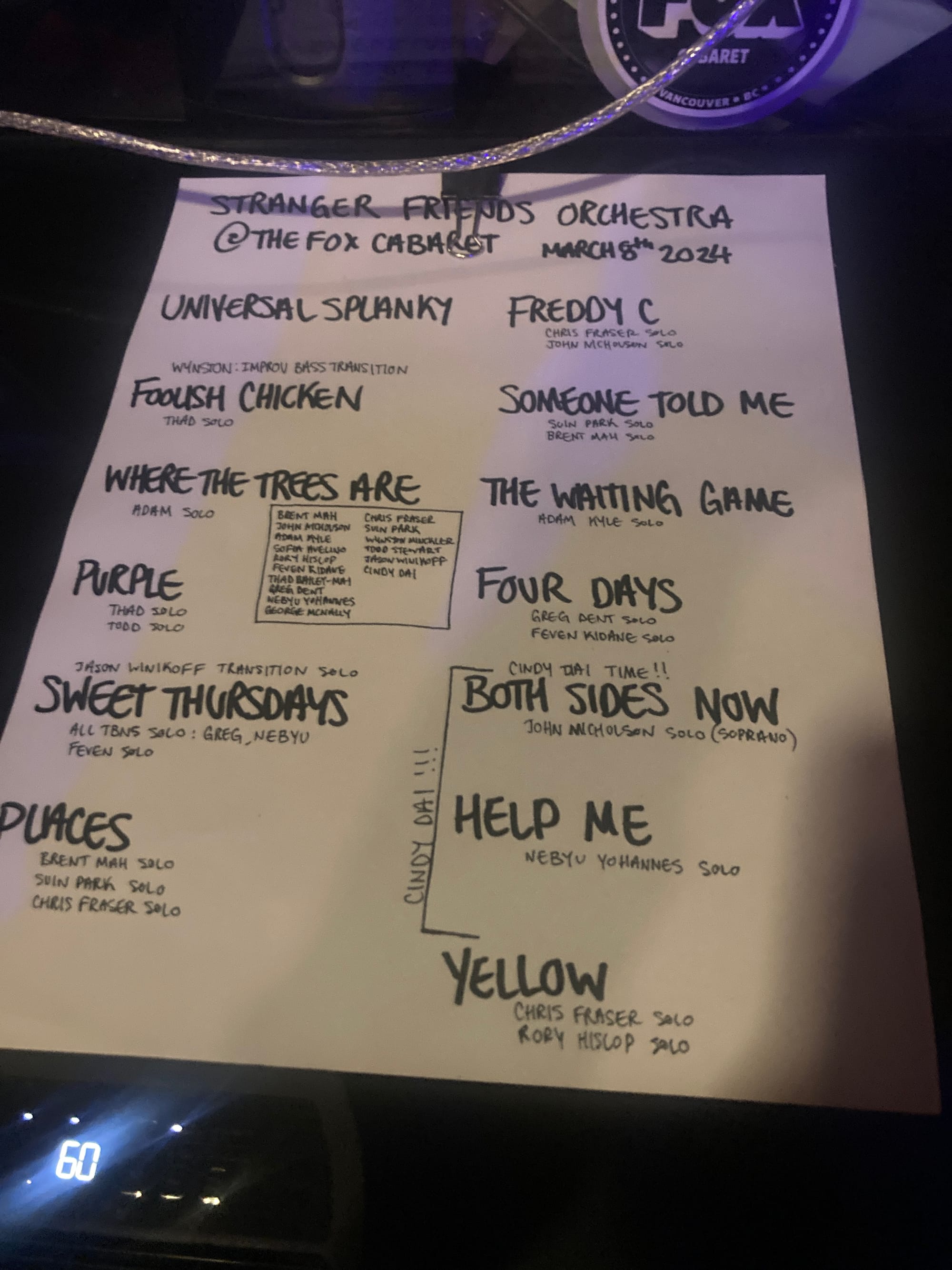
This is the second time I've written to you after hearing Dean's big band. Looking at the setlist in that 2022 article through the link, I can see what the new tunes were this go-around: the bossa "Someone Told Me" where Brent Mah's saxophone solo was the musical highlight of the night, "The Waiting Game" with heavy riffing that would befit Hard Rubber, and the Joni songs. Plus the brief overture and intro-talk vehicle "Universal Splanky", which came as advertised – a mashup of the orchestral opening to so many movies, and the Count Basie classic.
But like that previous night, the real highlight was the after-hang. Two years ago, it was a couple hours in the same space, Brentwood; this time it was a rolling three hours at The Pleasant bar and eatery, up a block and across Main Street, where I was part of the first table to show up (I'd like to thank two of my friends for bringing me in there) and eventually almost the entire band filed in. Dean's band continues to be the social beacon for my generation in this scene.
Emptying the notebook a bit more:
- The night was a crucial Infidels Jazz benchmark, setting the tone for Tim Reinert's next chapter: bigger shows, bigger rooms, and less-frequent series. Heading into this spring, Tim has quietly cut smaller series – jazz at Chill X, the Painted Ship, and the Heatley are no more – while setting up The Pearl, the VIFF Centre, and even the Hollywood Theatre later this month with touring artist Ibrahim Maalouf.
- My friend Anthony Cenerini recorded both sets. Since, as Dean said above, the band didn't get a Canada Council grant to go into the studio, I hope to see them put together a live album from this show.
- Wynston Minckler played a free and unaccompanied bass solo, understated on the setlist as "improv bass transition". I rarely hear him do that and wanted more.
- This show was my first time hearing the charismatic percussionist Jason Winikoff in person. It's no wonder he plays often and presents music from his engagements with a variety of folk traditions from around the world, with how gregarious he was up there.
- "Places" featured an epic unaccompanied piano solo by Suin Park, whom I know mainly from playing in Gordy Li and Feven's co-led projects. Dean told me additionally, outside of our interview, that Suin didn't pre-meditate any of the solo, nor she did have any guidance from him on what to play. She nevertheless captivated us.
- In the baritone saxophone chair at the front, Sofia Avelino felt like the player-captain of the band. She kept the stage illuminated with her attentive eyes, laughs, and smiles around the ensemble, and to its director.
- Further to what Dean said, the three-trumpet section has such diversity in its raw talents. You have Rory, who was an exciting soloist in the Bill Clark mold; Feven, whose featured playing was a centre of gravity that got us cheering often; and Thad, ever subtle and cerebral.
- From the second tenor chair, John Nicholson didn't just double, he quadrupled: tenor sax, soprano sax, flute, and clarinet.