esperanza spalding at the Chan Centre
Aug. 29: Spalding was retrospective with Matthew Stevens on guitar, Morgan Guerin on sax/keys/bass, & Eric Doob on drums

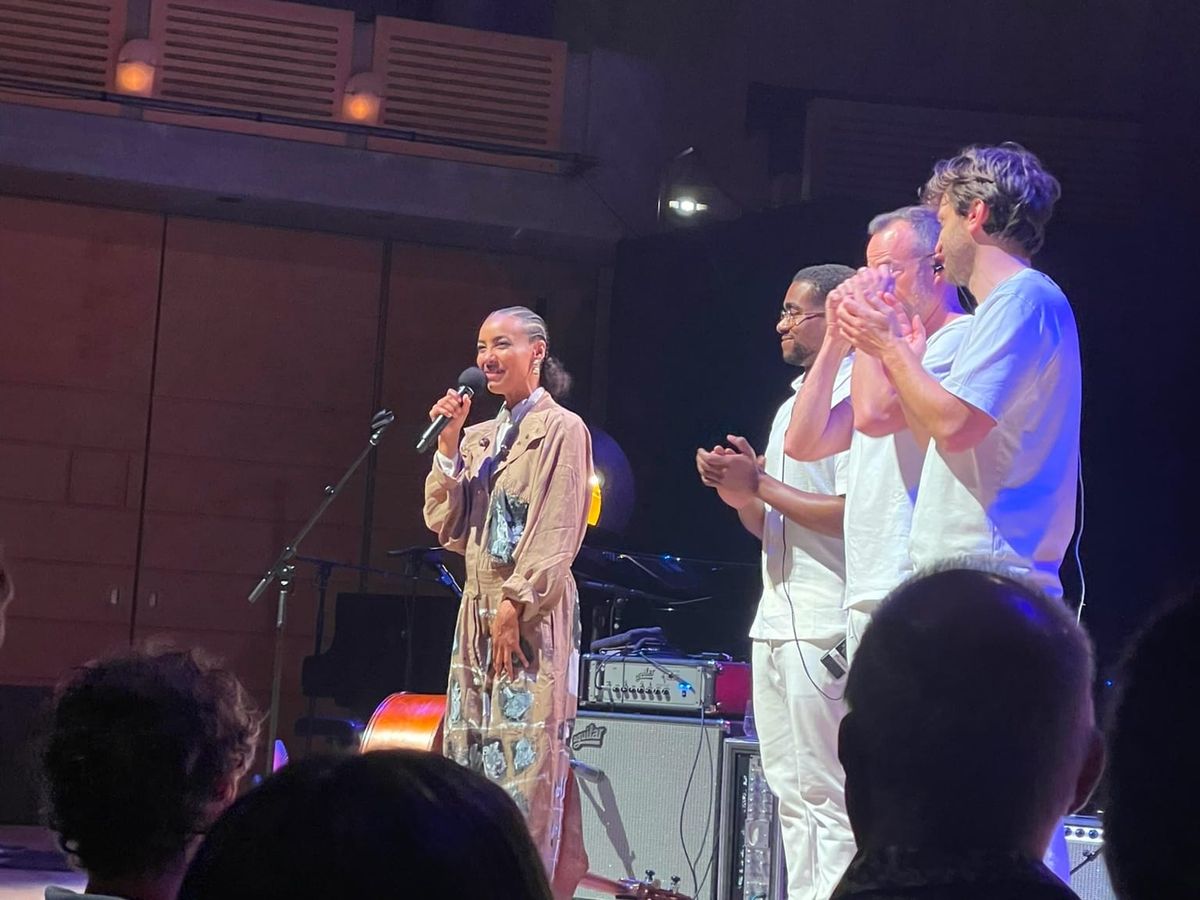
esperanza spalding played the Chan Centre's season-opening concert on August 29th. She didn't have a new album out in 2025, and she wasn't on a big tour. That said, she had played a run of dates earlier in August; she was coming right from a Chicago Jazz Festival show and would head next to play Robert Glasper's Black Radio Experience in Napa.
In her band were her frequent collaborator Matthew Stevens on guitar, multi-instrumentalist Morgan Guerin, and Eric Doob on drums. She led them out at a comfortably slow pace, then she picked up the upright bass and began enumerating frantic vocals.
"So, have you prayed to your phone today?" That lyric from the show's first song could jolt an anxiously affluent demographic, but Spalding prefaced it with enthusiastic talk about how we were here to be in the moment. "Dancing the Animal (mind)" was one of six songs on the setlist – half the show – that came from her 2018 album 12 Little Spells. The songs from that album, including the one that was up next, all have parentheticals.
To dial up "Thang (hips)", Guerin made his first instrument switch, going from tenor saxophone to organ. Stevens shone on guitar with massive tones at the right volumes for every occasion. Spalding exhorted the audience to dance, and the venue staff turned up the house lights for some reason. They must have realized that this move wouldn't encourage much dancing, even seated dancing, and reversed course after a few seconds.
When Spalding put down the upright after two songs, she never played it again. (We couldn't hear it that well in the live mix to begin with.) She switched to electric bass for her most-streamed track: "I Know You Know" from her self-titled 2009 album. Some people applauded in recognition from its first few words, even before her mellifluous jazz-lick of a hook hit in the chorus.
Spalding introduced "With Others (ears)" with academic but playful talk about some kind of theory she'd been developing. Suddenly the show had some sharper angles again, back from the brink of Jon Batiste-ville. "I've been learning about psychology, neurobiology, and the rest / Now I can't rest, because everything reeks of basic needs", Spalding sang in a surprisingly Ornettey unison with the band.
Then she sat at the grand piano for "Formwela 5", one of a dozen similarly named pieces from her 2021 album Songwrights Apothecary Lab. (The album skips Formwela 12; track twelve is Formwela 13. Spalding has a Songwrights website where a Formwela 12 exists as a multidisciplinary art piece. This show had twelve tunes, and there's of course 12 Little Spells. Did Taylor Swift simply increment and copy Spalding's numerology? The people want to know!)
For "Formwela 5", Guerin switched to electric bass. His versatility, and Spalding's ability to make you feel like you're beside her at the piano, made this number one of my favourites.
Spalding featured Stevens on "Our Reunion", the closing track from the guitarist's 2017 album Preverbal. She talked about how she wrote the jazz-rock song's lyrics at the last minute, not just the day of the recording session but in the session. She said she drew inspiration from her family's history in Arkansas, crossed her fingers that the resulting work would come across truly and honestly, and later reflected that it did. Then she named a legend of the music with whom she shares a deep link, quoting an expression that obliquely suggested what it might've felt like to receive those lyrics at the last minute: "Wayne used to say, it's like the echo before the sound."
Spalding would talk more about Wayne Shorter at the very end of the night. First she played three more Spells: "Lest We Forget (blood)", "Touch In Mine (fingers)", and "All Limbs Are (arms)". Other than Doob's drum samples on the first of those three, they didn't stand out in my memory of the show.
The rest of the music originated from Spalding's mid-twenties. That's when she famously won Best New Artist at the 2011 Grammys over four pop superstars who haven't all aged as well as her: Drake, Justin Bieber, Mumford & Sons, and Florence + The Machine. "Little Fly" is based on a William Blake poem and is the opening track from 2010's Chamber Music Society, the album of that moment. Unlike the recorded version where strings back her and her upright bass, Spalding sang it a cappella with Bobby McFerrin-like self-accompaniment, creating the most enchanting moment of the show.
Spalding sings with agility and personality in the high register, rarely going below middle C. But when she hit the low E-Flat at the end of the piece, I was floored. She introduced the last song of the set, "Black Gold" from her post-Grammy album Radio Music Society, as one dedicated to uplifting the men in her family. It's another song that has the retro style of "Thang", but it landed better. Guerin, Stevens, and Spalding sang three-part harmonies in an extended outro to keep the party going.
They made us wait but did come back for an encore. After the applause piped down, someone shouted, "Milton!" They were correct to note that we'd heard no tracks from Spalding's latest record, 2024's Milton + esperanza. Spalding said no, we wouldn't have any Milton tunes tonight. The album is nevertheless a treasure, as is this NPR Tiny Desk remote session from Milton Nascimento's home:
Nascimento and Wayne Shorter made the album Native Dancer over 50 years ago, freezing a moment in time for their two historic careers to intersect. Shorter, before his passing, wrote the music for an opera called ...(Iphigenia) that featured Spalding's libretto. Spalding had played bass with Shorter. Now Nascimento and Spalding made a record together, and that's the burning flame of this music in the flesh: that's it. That's the tradition.
The band's encore was "Endangered Species", composed by Shorter. Spalding's version of it had come out on Radio Music Society. She talked about how she'd written lyrics to the tune when she had opened for Prince in Atlantic City, New Jersey. She recalled being told that Shorter didn't like people writing lyrics to his tunes, but when she mustered the courage to email him about it, he liked them.
I'd known before walking over from the UBC Rose Garden into the Chan that Spalding, at age 40, could no longer just be labeled the prodigy whom Barack Obama picked to perform at the Nobel ceremony. (That was before her huge Grammy moment!) What left the biggest impression on me after the show was how deeply she had embraced being not yet an elder of course, but a veteran. She'd already done so much by 40 that a retrospective set could only get to half of her albums. And in that set, she spoke plainly about wise themes: immutable family ties, our relationships to the land.
However, she also dropped that psychology lingo. I know an extremely fast thinker when I see one, and Spalding to me seems like one of those people with a gaming PC of a brain. Her banter suggested that she wants nothing more from her spare time than to think up esoteric theories about the human mind, body, and condition. But the charisma that has carried her beyond jazz circles into more general stardom is always there, so no matter how weird she continues to be, you'll feel like she looked you in the eye.