What's next for the Fort Langley Jazz & Arts Festival?
Returning from the infamous 2023 fallout, the festival slimmed down and isn’t going anywhere

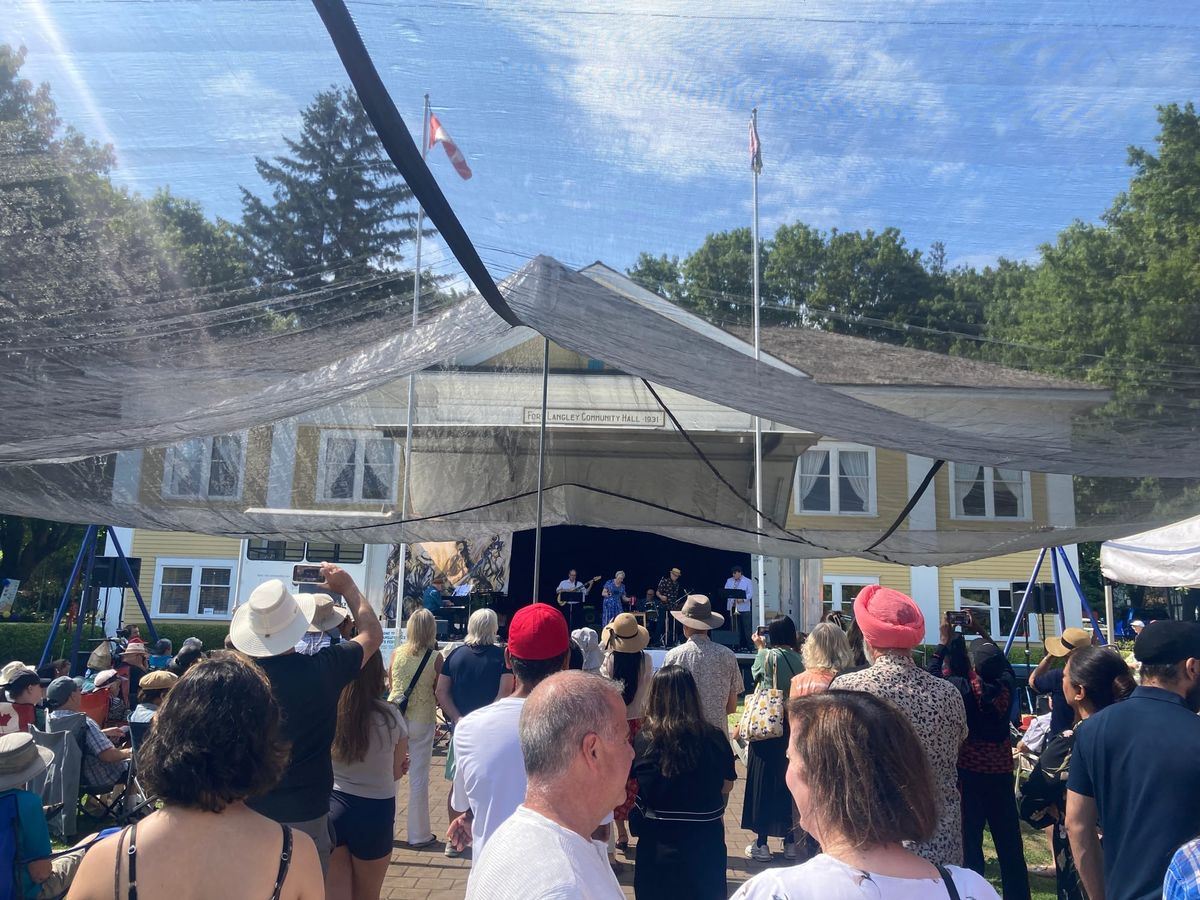
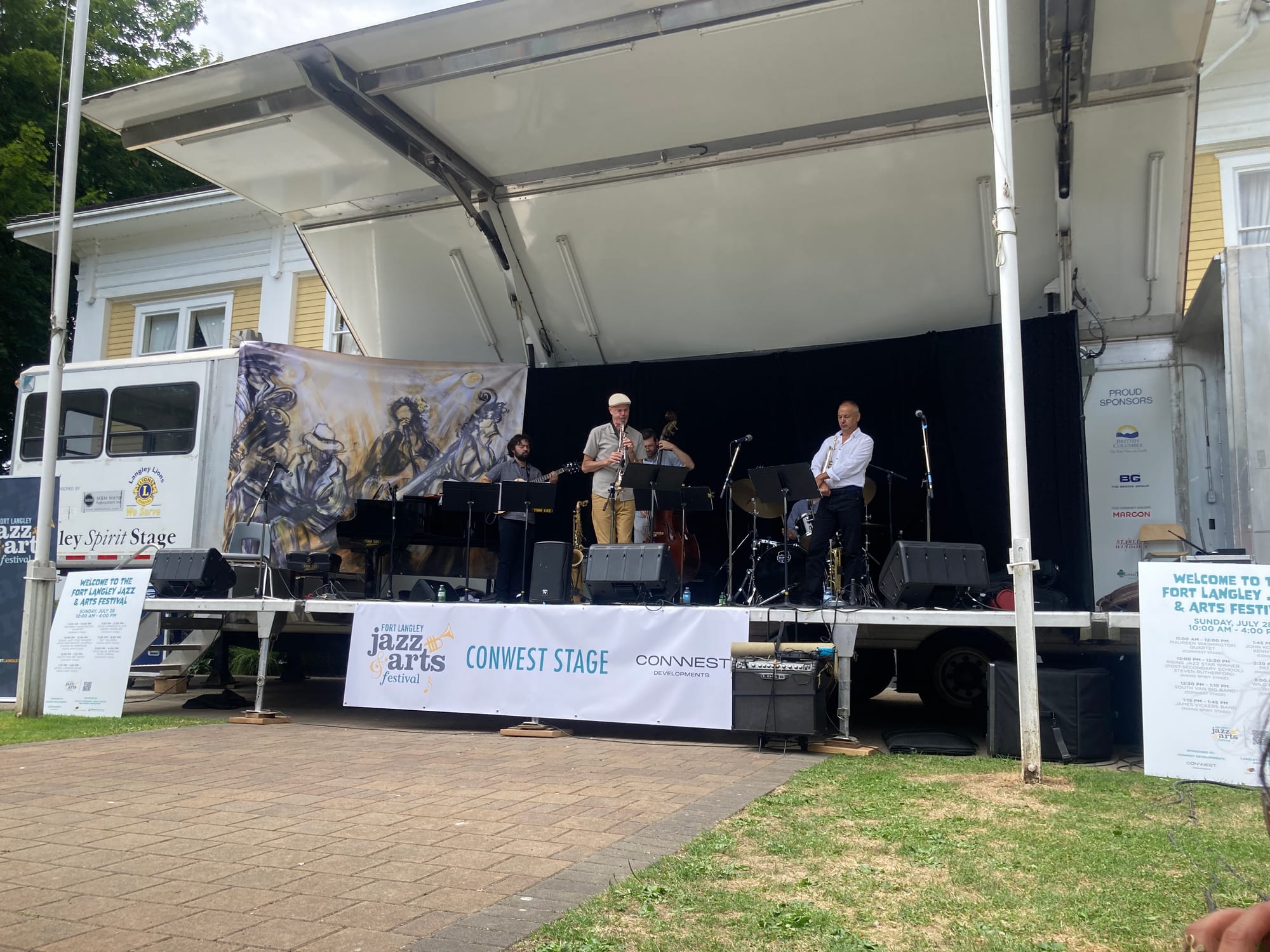
Only a handful of minutes after 3:00 PM on a hot and dry Sunday, July 28, 2024, the final act of this year's Fort Langley Jazz & Arts Festival is ready to go. A few hundred enthusiasts gather beneath mesh that blunts the sun's rays. Some of them stand while others sit on the lawn in their folding chairs. Vocalist Darlene Cooper and pianist Bill Sample count off their R&B-influenced band, Wild Blue Herons, with Miles Foxx Hill on bass and Randall Stoll on drums. The billing on the sign in front of the band reads Wild Blue Herons with Horns; saxophonist Tom Keenlyside and trombonist Jim Hopson wait stage left, and a piano occupies stage right.
"I was pleasantly surprised that the piano was in such good tune after having sat outside for several days," Sample says to me later. "I was actually surprised that Tom Lee Music would be okay with that."
The main stage emerges from the cross-section of a truck that parks in front of the historic Fort Langley Community Hall. You can see it from across the one or two village blocks which form downtown Fort Langley and the de facto festival grounds. The artistic director, Dave Quinn, ambles from the hall's side-door exit to the front of the stage. He wears one of his signature floral shirts, shorts and sandals, and sunglasses plus a hat pulled closely over his forehead toward the sunglasses.
Quinn takes up his wireless microphone and becomes an off-the-cuff emcee, avoiding a delayed start. His introduction omits the first word of the band's name, and he pronounces their animal symbol like HURR-ons, or was it hurr-ONs?
"Please welcome, Blue Herons with Horns!"
Quinn is the co-founder of the festival's non-profit society, incorporated 2018, with his wife, Karen Zukas. Sitting down together on speaker phone for a post-festival interview, the two settle into roles of communication that seem to me equally emergent and intentional: Zukas the calm leading voice, Quinn the raconteur-musician, a woodwind player.
"It felt like we hit the secret sauce this year," Zukas says. Quinn concurs, nodding to his own work: "I think we really hit it out of the park with the programming this year."
While Killer Mike headlined the 2024 Vancouver International Jazz Festival and Infidels Jazz began leaning into anime music presentations, this festival – like Frankie’s Jazz Club, you might say – is resolute in booking mainstream jazz and blues. "We are a boutique music community festival," Zukas says. "We know, after some years now, who our audiences are. We know the kind of music and programming that appeals to them. We know how far we can push the boundaries [...] Dave does certainly aim to educate, inform, encourage different people, and expose them to different music and such; but also, we are very cognizant of not trying to force genres of music on our audience that they are not interested in."
The first salvo of festival programming is the big band show on Thursday, during business hours. According to Zukas, it's a hit with the local demographic who can make the 1:00 PM start. "We’ve done that now for three years, and it was sold-out this year with people lined up the street trying to get a ticket. A Thursday matinee, to see Fred Stride's Orchestra in the tribute to Duke Ellington!"
Another ticketed event is the Cool Blues Show on Friday, where Quinn's lineup is full of notable blues acts: Tom Lavin and the Legendary Powder Blues, Kenny "Blues Boss" Wayne, Rick Estrin and the Nightcats, Kingston-based singer Miss Emily, and a tribute to B.B King by Silent Partners, whose drummer Tony Coleman was a longtime King sideman. Zukas says that the show “went from two nights last year to one night this year, two stages last year to one stage this year, and that model worked really well. We sold more tickets than we ever have, we sold out our VIP tickets at the Blues Show. Our bar ran out of beverages near the end." We didn't sort out whether the total number of tickets was higher in one night than in last year's two, or if per day the afternoon-long affair at Fort Langley Community Park was fuller.
Then, there's the biggest draw for me: the free-to-attend weekend jazz programming.
The weekend lineup includes Cuban-Canadian pianist and Arturo Sandoval alum Hilario Durán (though a lineup listing on the official website dubbed him "Hilary Duran"), prominent Alberta bassist Kodi Hutchinson with pianist Chris Andrew in the Hutchinson Andrew Trio, and Vancouver's own John Korsrud playing the music of a fellow Canadian trumpeter-composer, the late Kenny Wheeler.
I make sure to show up in time for the start of Korsrud's set on Sunday afternoon. He presented the Wheeler concept at Frankie's After Dark back in May; Jon Bentley on soprano and tenor saxophone and Conrad Good on bass are returning from that gig, joined by Tristan Paxton on guitar and Bernie Arai on drums. The Tom Lee piano is, for now, untouched. In terms of the two Wheeler albums on their setlist, they have the Deer Wan lineup as opposed to the Double, Double You. It's a strong band with connections to other GenX ensembles of the moment: two members of Sharon Minemoto's quartet, three members of Bentley's own.
The band plays "Kind Folk", the modern Canadian jazz standard so well-covered at Capilano University. "We've got 13 minutes," Korsrud says on-stage as he considers how many tunes they have left after the transition forced them to start late.
The next piece is one that Wheeler wrote for the Hard Rubber Orchestra, Korsrud's longtime ensemble. Korsrud recalls getting those scores in the mail from the composer. He's amused. "I didn't like it!" he says about his initial reaction to the movement they're about to play, which to him sounded like "a 1975 BBC TV theme […] cheerful and tuneful."
"Hard Rubber Orchestra commissioned Wheeler’s last major work in 2014," Korsrud says to me afterward. "He would pass away a year later. We performed a condensed movement from that suite."
Up next after Korsrud is Wild Blue Herons. I take some time between acts to stroll down the block and catch a bit of workshop programming: a talk by my friend Chris Wong. "Book Talk: Journeys to the Bandstand, Thirty Jazz Lives in Vancouver (FREE)," reads the festival signage in front of St. George's Anglican Church. At the door of the multipurpose room, before I can join the conversation around Chris at the back, a volunteer asks me to pay a few dollars.
Chris welcomes me in regardless, complimentary. "He's media!" Chris says about me.
After the talk, I return for the Wild Blue Herons with Horns. They sound solid, like they did earlier this year at Frankie's, as well as at New Westminster's Anvil Theatre in a now-concluded series booked by their saxophonist Keenlyside. "Darlene and I were both impressed with the quality of the live sound and the crew was fabulous to work with," Sample says later. "We were happy to have been given a prime-time slot on a Sunday afternoon, with an enthusiastic crowd. So from our perspective, a very good experience."
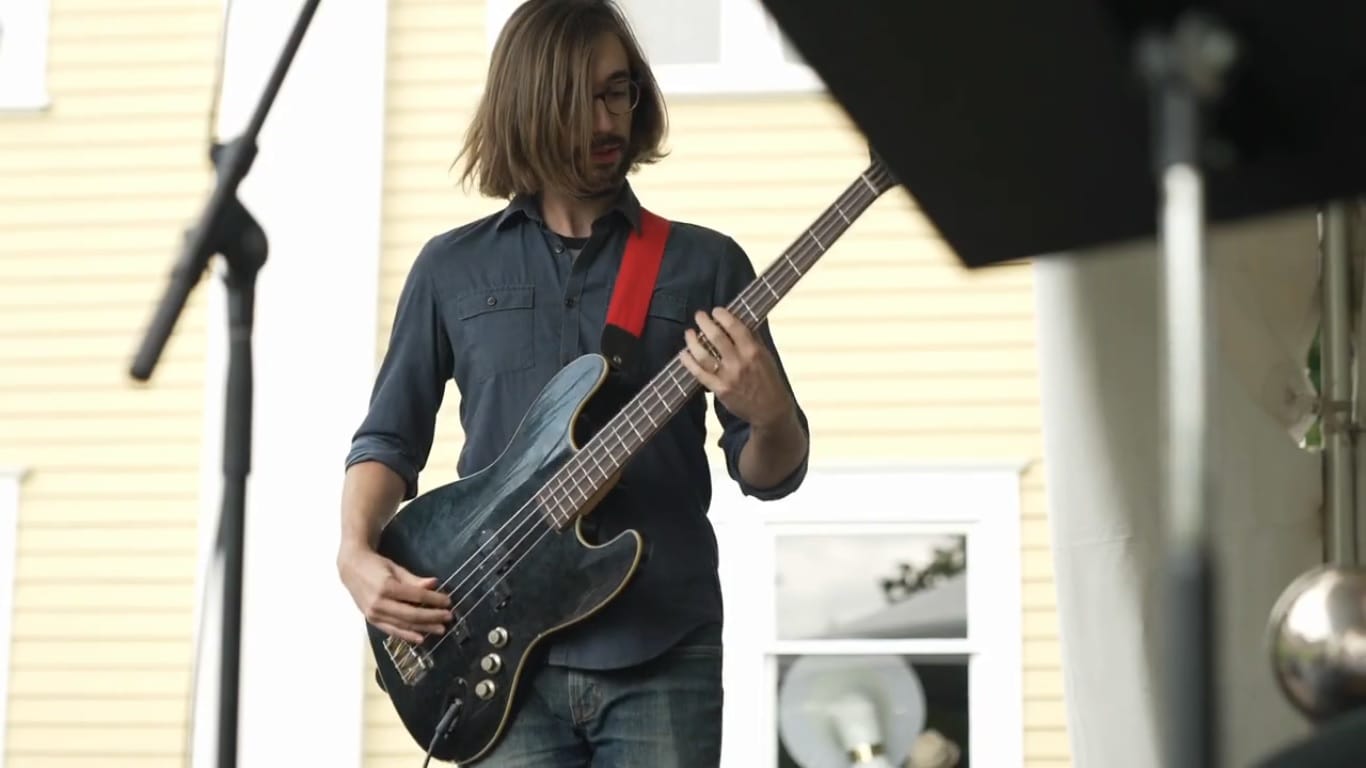
(I also want to disclose that I played the festival once, in 2021, and that I sold a sponsorship to the festival society earlier this year at Rhythm Changes, promoting applications to a weekly youth concert series that they presented in the lead-up to the festival. For good measure, here’s a photo of me from when I played there.)
At last year's festival weekend, I darted between four stages in the village, hearing artists from Feven Kidane to Omianan on the Saturday, and from Raagaverse to the Marois Vocal Project on the Sunday.
This year, I look around for that experience again. I don't see it. A second, smaller stage which the festival uses to alternate the setup and presentation of acts is beside the main stage. There are seven jazz and blues artists per day combined on these two stages; on the 2023 gig list, I noted 15 per day across the four stages.
As for the two-stage setup, paired with a decrease in jazz acts presented, Zukas says it's a feature, not a bug. "By consolidating everything in that area, it really provided an opportunity for people to enjoy everything. Compared to the previous year, we would have multiple stages spread throughout the village, so it was more spread-out. But this year, it really worked with consolidating the festival and bringing it all in together in front of the community hall."
Quinn agrees that they right-sized the weekend stages. "It saved us a lot of money too, having less stages and having less production, which is great. We're still able to, you know, it all worked well as far as the management of what we could afford."
What we could afford has always been a hot topic for any festival; Quinn, however, has been feeling that heat more than arguably any other jazz presenter in the country.
On August 18, 2023, Venezuelan-Canadian artist Susana Williams posted to Facebook what would become the most-discussed single social media post in the Vancouver jazz scene last year. "My Latin Jazz Quartet and I performed at the Fort Langley Jazz and Arts Festival on July 22, 2023," Williams began. Her post went on to allege that, despite having a contract to be paid immediately after her performance, she had yet to be paid after nearly 30 days. The post included status-update messages attributed to Quinn: "We are still processing our ticket sales and adding received revenue to pay you and everyone else. We'll be sending you an e-transfer."
"I wanted to let you know that we are reconciling the event and will get back to you shortly."
“While the overall festival was a success, unfortunately, we experienced soft ticket sales and lower than expected food and beverage sales. It is not what we planned or expected."
At least seven musicians and one live sound professional who worked the 2023 festival commented that they, too, were still waiting to be paid their contracted fee. Typing hundreds of comments on the post and on other concurrent posts, musicians from around the community decried the apparent scenario of volatile revenues being allowed to impact artists' payouts.
Williams' concluding assessment of the situation, in which she doubted whether she would get paid at all, was scathing. "People who receive government money to run festivals shouldn't use these events as a personal playground and as a self-promoting opportunity. I am not worried about burning this bridge or any other bridge that condones this kind of behavior."
Williams returned to Facebook on September 18, 2023 to confirm, with righteous indignation, that she got paid; as of that same date, I heard back from individual artists whom I had contacted. Everyone who got back to me said that they had been paid, and some of them mentioned a 10% bonus added to their fee. This puts the likely total delay for most artists at somewhere between 50 and 60 days.
When I bring up the subject to Quinn and Zukas, they aren't surprised that I'm asking. "Yeah, that was a very difficult situation last year," says Zukas. She notes repeatedly, as if to quell a perceived game of telephone, that everyone was paid: delayed payments, not non-payment. She mentions the 10% bonus, saying they added it to all of the late payments.
"We did not want to enter into a public debate online. We don’t think that was really appropriate to do," Zukas says. Nevertheless, several comments from Zukas' Facebook account populate the replies to Williams' original post: the revenues were slim, the expenses higher than anticipated, the delay unacceptable, we're working on it. And this statement: "While Dave signed the contract with you, I as the festival ED [executive director] take responsibility for this situation."
Quinn and Zukas say they felt no residual impact from last year's shortcoming while booking artists for the 2024 festival, and that in fact, they received more applications than ever. I find this claim surprising.
Zukas emphasizes a theme to me which also ran through her Facebook comments: this can't and won't happen again, she says. "It’s not something that we wanted, of course, to experience, and when we apologized to all the artists that had delayed payment, we explained the situation. And then we also explained, how going forward, that we would never let that happen again.
"In the six years prior of hosting the festival, that had never occurred […] This year, we put in some policies and practices to ensure that would never happen again, such as all artists receiving 50% advance payment prior to their gig, when they signed the contract. And they were paid immediately after the festival. We set aside funds to ensure that all artists were paid.
"We learned from the experience, and we recognized that we could’ve done things differently in 2023. We made sure, with our practices and policies this year, that that did not happen again."
I ask Quinn if he wants to offer an addendum. "No, I really don’t have much to add with that."
Lida Magnus, whom I interviewed last week at Rhythm Changes, works as the volunteer coordinator at the 2024 festival, a paid position. Her experience was positive enough that she feels it's quite possible she'll be working there again next summer, when she comes home from her first year of law school in Edmonton.
Magnus carries herself like the kind of young person any festival would want on their team. She's a "social butterfly" by her own admission and a keen musician whose motivation on her instrument never had to be propped-up by the demands of studying music post-secondary – she took a Bachelor of Commerce at UBC. Raised in Langley, Magnus had attended the festival before, multiple times. She tells me that the coordinator position seemed to her "like a summer job made in heaven".
"I was responsible for scheduling, recruiting, orienting volunteers, and communicating with them. I'm honestly such a people person. I just got to interact with a hundred people who also love jazz so much that they want to volunteer their time to help out with our jazz festival."
Magnus tells me about the Blues Brothers Revue Show & Dance, a Saturday-night ticketed event inside the hall. "I loved the Blues Brothers show, I had a really great time," she says. This third piece of headline programming wasn't on my radar. Peter Juric plays Jake Blues; Tom Arntzen plays Elwood.
Seven other musicians, from Wild Blue Herons' Sample and Stoll to top lead trumpeter Derry Byrne, complete the Blues Brothers band. Whatever misgivings these professionals might have developed as a result of the 2023 festival, here they are.
Having heard the outdoor sets on Sunday, I catch the 562 bus to begin my trek back to Coquitlam; unfortunately, I can't stick around for the Jazz Alternative Worship Experience featuring Maureen Washington's quartet. As the bus approaches the southern tip of the village centre and turns onto 96th Avenue from Glover Road, I realize the festival is meeting the same fate that befell their big cousin to the west two years ago: the loss of a tentpole sponsor. Odlum Brown's name is absent from the title.
When Zukas looks ahead to 2025, she is cautious about the economic trends that she sees. "The amount of grants that were available and the grant funding have decreased. Sponsorship funds have decreased because of the economy. We had a lot of new sponsors this year, for example, but the sponsorship amounts we're seeing are less, because of the economy. They want to support, they want to be involved, but they’re affected by the economy as well."
I don't have a robust accounting of either the festival's revenues or expenses, but from public grant reporting, I can observe a rising flow of grant funds en route to last year – at least $22,000 received in 2020, $64,000 in 2021 to continue producing streamed programming, $108,000 in 2022 to reopen in a big way – then back down to at least $62,000 received in 2023, lower than two years prior but with the obligations of a full-steam-ahead, in-person live event.
"We’re a small, historic community here that has its own kind of unique vibe to it," Zukas says. Despite the natural questions about who will next agree to play for them, where the money will come from, and how it will reach the artists, all signs point to another full slate of programming next year. As I wonder if anything could discourage, or even dislodge, the executive and artistic team, it becomes clear that their fervour is undiminished.
"We’re both volunteers, we don't get paid for what we do," Zukas says. "When we were adding up our volunteer hours, because we have to report on that to a couple grant funders, we estimated that Dave and I each contribute about 2,000 hours a year to the festival, planning, preparing, implementing, and running the festival along with our board and volunteers. We do it for the love of the music, for the love of our community, to contribute to our community and to live music, arts and culture."