Meeting Joe Williamson
He joins Let the Monkeys Dance Feb. 21 & plays the raw, minimalist songs of new album Zombie at the Hargrove Feb. 22

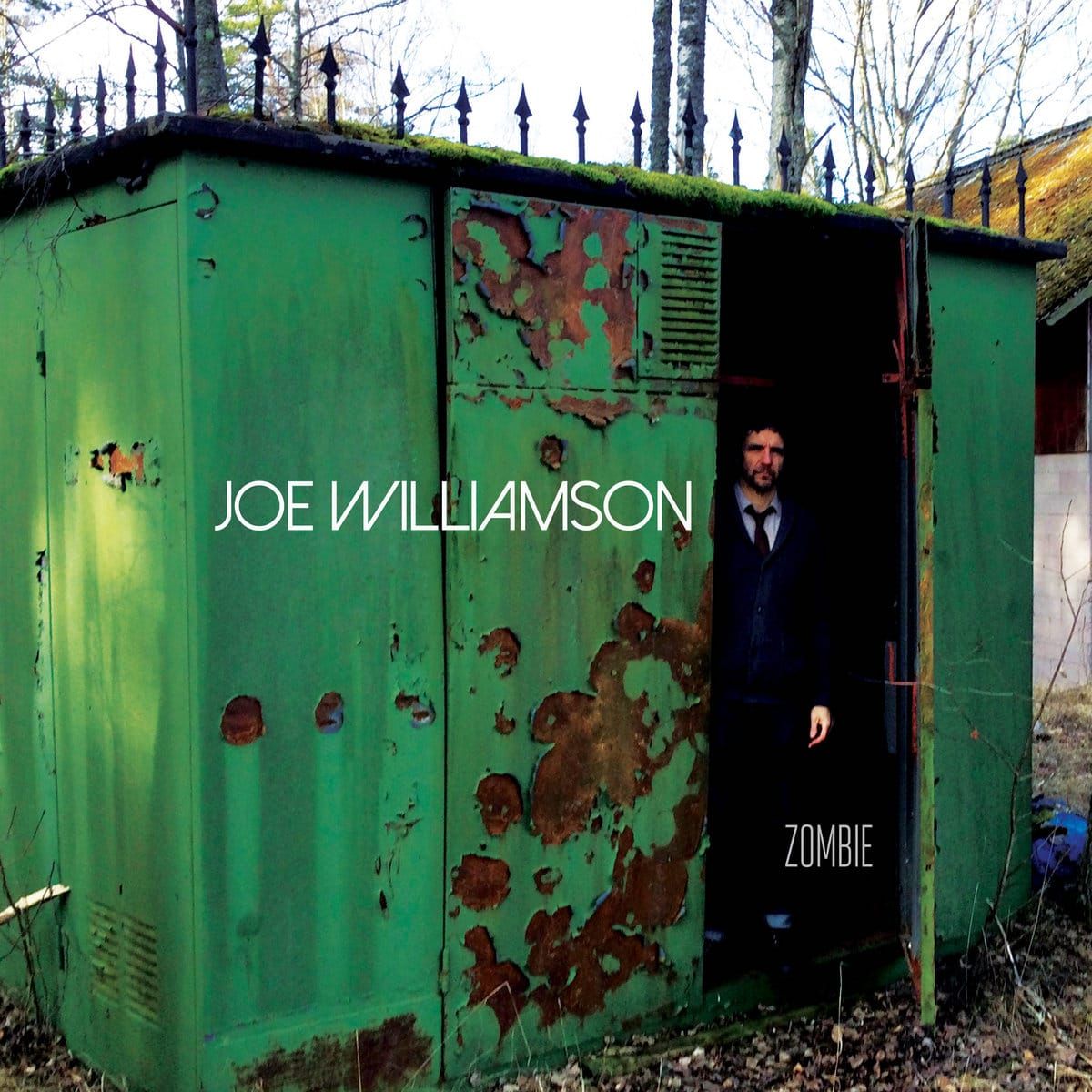
Bassist, guitarist, and singer-songwriter Joe Williamson and I spoke for the first time at a restaurant in Maple Ridge earlier this week. Our interview took place just before the 2026 edition of his roughly annual run of homecoming shows.
This Sunday, February 22nd, Williamson plays The Hargrove's Lost Dog Sundays series (on a bill opposite rebsha, the duo of Feven Kidane and Nebyu Yohannes). He presents the music of Zombie, his new album of raw, minimalist, postmodern songs.
I first heard Williamson in 2024 – twice, on back-to-back nights, playing electric bass – though we didn't meet. First, at 8EAST on March 13th, he improvised in a group celebrating Cole Schmidt's birthday. The next night, he played Tyrant Studios in a band called Let the Monkeys Dance with James Meger also on bass, Schmidt and Tony Wilson on guitars, and Kenton Loewen on drums.
Tomorrow night, Let the Monkeys Dance return to Tyrant presented by Infidels Jazz. They played Nanaimo's Vault Cafe last night on a bill with drummers Chris Corsano and John Brennan, who just released their album Buzzing With Rumours on Mint Records.
"It feels like a band, even though we play like one gig a year," Williamson said of Let the Monkeys Dance. They made a recording here last year after doing a show at the Lido, though that recording's future release date is uncertain.
Williamson grew up in the lower mainland, left for studies at McGill at age 18, then went to Europe around age 22. He has lived across the pond ever since that move in the early 1990s. "We were in London, and we went to Amsterdam, and then we were in Paris," he said. "I was playing music on the street with Tony Wilson, and then I ended up staying in Amsterdam, and I was there for six years." Next was Berlin, then back to London and finally to Stockholm, where he has lived for well over a decade.
Williamson built a long resume in European experimental music. My look through that history began with the Swedish band Receptacles: Williamson on bass and vocals, Anton Toorell on guitar, and Dennis Egberth on drums. When they came here to play Ironworks for Coastal Jazz's Innovation Series on June 21, 2019, Schmidt wrote about them for the festival blog. He called Williamson "a true-blue dry-wit mystery man".
Receptacles' albums have threads of absurd talk-song that run through to Williamson's current singer-songwriter music. On Freedom from Error, released in 2016, "Old Guy" features Williamson plucking bass and talking over a dirge of alternating chords: 'Who's the old guy hanging around with the cool kids? / He's crampin' their style, he's scaring away the girls'. The old guy resembles the narrator on the Zombie song "14 years": 'I saw her there standing by the bar / she looked so good, I wanted to talk to her / I had some questions I'd written down that she could maybe answer'.
A completely different animal, however, is The Ägg: a collective of multiple guitarists, bassists, and drummers using cues that Williamson designed. One of the tags on the Bandcamp page for their 2016 album Machines calls it nonmusic. "I invented the rules, but I wasn't actually in charge of any of them," Williamson said about the structure and its results. "Everyone basically just played a riff but would try not to sync up with anyone else, be a completely different tempo and everything to everyone else."
Zombie came out this past September on a one-person label called sing a song fighter, a near-homophone to how I could describe Williamson's latest work in Swedish-accented English. Its founder, Karl Jonas Winqvist, writes in its online profiles about running it "from the kitchen in Gubbängen, Sweden, while making omelettes for the kids." This statement of bare vulnerability suits Williamson's music.
Williamson also runs his own boutique label called Tilting Converter with a fellow member of The Ägg, Patric Thorman. Basically all of the album descriptions on Tilting Converter's Bandcamp page carry Williamson's distinctive written voice. It has irony, informality, and many references to Captain Beefheart (whose music I admittedly haven't really checked out).
I got a look behind the curtain on the Machines write-up, which I read before meeting Williamson and found audacious. "I would find these research science PDFs, and then I would sabotage them," he said. "Write our names and change, if it happened to be about... I can't remember what they were about originally, but anything that was ‘visual’, I would change it to ‘sound’. And then I would put in ‘music’ and just try and make it as confusing as possible."
"There have been a couple people who have said that they understood the text, and I was like, oh, you should probably go to the doctor if you understood that," he laughed.
A compositional concept, specifically an embrace of limits, unites Williamson's many different-sounding projects. "I guess every kind of thing you write, once you start it, even if you write a complicated jazz song or a thing you want to do for a whole bunch of people, the piece will start to have a logic. It’s kind of too late to fight it. You've set the thing in motion, and it's just a matter of making sure that it becomes. Because I play guitar in the way I play, that of course limits... you’re never gonna get a really complicated song, first because I can't sing it, and I wouldn't be able to play it on the guitar."
On Zombie, the only accompaniment is a nylon-string acoustic guitar, strummed with the thumb. "I originally had this idea that I would have pedals," Williamson said, "and then the closer I got to deciding to record, I knew that I wanted to have just an acoustic. We had a contact mic and an amp in another room, so there's a mixture of the amp, sometimes there's a little bit of distortion. We didn't want to record with any effects [...] it was basically one mic and then one on the guitar."
One song with that distortion is "Incantation", the record's most stark commitment to repetition and minimal songwriting. Its single two-word lyric cracks the edges of Williamson's voice.
Toorell, from Receptacles, recorded and mixed the album. Williamson described a recording hiccup that they did additional takes to overwrite but that would've probably fit on the record, given its honesty. "There were a couple songs where I couldn't stop moving my foot. It was in this basement that was really cold, and Swedes, they don't wear shoes indoors. But I knew I would freeze my ass off if I was just in socks. So I had a pair of runners on, and on the leg of the chair, you could hear this [squeaking sound]."
"We finally figured out it was my left foot," he said.
The campfire chords and bouncing melody of "Nice to Know" make for Zombie's most accessible track. Williamson moves from place to place and, as things twist darker underneath the happy musical setting, keeps landing on a refrain: 'It's nice to know that I can do whatever that I please'. Later do becomes be, and I can becomes you will.
"Don't ask me", sporting a Ramones-like riff, has that same happy bounce and physical journey by the speaker. 'Don't ask me where I've been 'cause I don't know', Williamson sings in ascent.
One of the hypnotically simple riff songs that stays stuck in my head is "Rain". Sung gentle and wispy at a slower pace, the song evokes grunge, Elliott Smith without the Beatles. Its abstraction sheds the two themes that I notice in many of the other songs: social observations and wandering. Exactly one repeated dyad of guitar notes is pleasantly out-of-tune.
I can't classify Zombie as folk, despite it having a man with a guitar. Williamson's decades as a bassist in new and improvised music, with collaborators like guitarist David Stackenäs, pianist Lisa Ullén, Eugene Chadbourne, and the band Trapist, sit too firmly in my mind. Instead of Nick Drake, and certainly not Jeff Tweedy, the posture is closer to Kurt Vile or even Pink Floyd.
Williamson welcomed my image of him as a social observer of a songwriter; it fit his avoidance of being typically confessional. "I don't want to share any of my private life," he said. "I think it's corny [...] And then also I don't think I have anything that would be interesting enough. Maybe I'm just thinking of things that I think are funny, or things that I've observed that have been funny." He continues, unflinchingly, to do just that.