John Doyle at the Rogue Folk Club
An Irish guitarist and folksinger with a fiddler's memory visits an ideal venue in turbulent waters

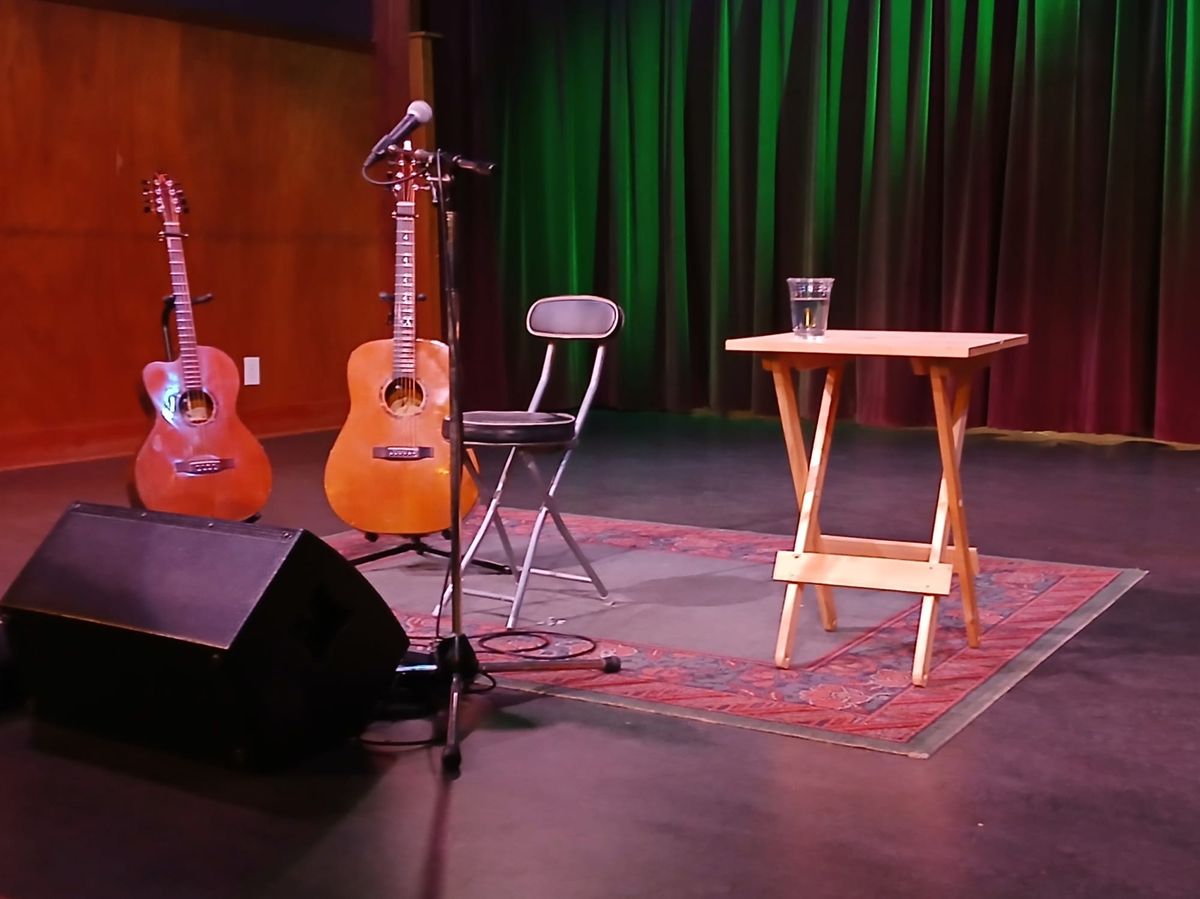
Irish guitarist John Doyle played a solo show at the Rogue Folk Club last night, Thursday, October 2nd. He started with the song "The Rounding of Cape Horn" or "Rounding the Horn". A lefty, he kicked into unparalleled time with his fast-picking left hand that never failed to follow the dynamics of his voice, loud to gentle and back again with great control.
Doyle didn't cross the pond to get here: he's been living in North Carolina for many years. He's on a nine-date tour of the west coast, which continues tonight in Mount Vernon, Washington's Littlefield Celtic Center and wraps up next weekend in California. He brought an octave mandolin to contrast his guitar and switched to it for the traditional song "I Know My Love", citing a version by County Cork artist Jimmy Crowley.
Doyle told a full story alongside pretty much every song. He told of the fisherman Robert Joyce and the Claddagh Ring, singing about a man who indentured himself. He let the subject matter go hardcore-folksong dark as often as it needed to; the frequent talk of ships and voyages implicitly sat against the news of the Global Sumud Flotilla's interception. When Doyle closed his second set with one of his better-known songs "Clear the Way", about the Irish Brigade at Fredericksburg in the American Civil War, he said that the song was about the civil war "that happened before".
Nevertheless, to follow the murder-ballad nursery rhyme "Burke and Hare" where a man called Knox "buys the beef" after bodies drop, Doyle sang a sea shanty, "Across the Western Ocean". (He got good crowd participation on sing-alongs in both!) That song, with its transatlantic call of "Amelia" like Earhart and its stories of Irish people immigrating in the potato famine, suggested that Doyle hasn't given up on his adopted America's promise just yet.
I've been into folk lately. I've been trying to tie together open threads from my twenties into something that carries me forward in the new decade. Part of that is continuing to love this music as much as other traditions that have nurtured me. In my time around violinists, I noticed that they use a linear kind of memory: you can wind them up by getting them started on the first couple bars of a fiddle tune, and the rest of the piece will come back to them like riding a bike, no matter how long it is.
Doyle uses this linearity as a singer. He'll introduce a song that he says he's never performed before, joking about how he's going to forget lines. The song is about a 1930s man who paints a truck in exchange for a ride but doesn't let the paint dry, or maybe uses the wrong kind of paint, ruining the suits of his comrades who hop in. Once or twice Doyle does forget the next line, but the momentum of his strumming and his voice-to-fingers melodic unity catches him up.
The hundred or so people at the Rogue Folk Club made it feel full, but on other nights (and with bigger bands), the venue needs more. On April 10th, in their newsletter under the subject "The State Of The Rogue", director and booker Steve Edge mentioned a March 23 concert featuring Lucy MacNeil of the Cape Breton group The Barra MacNeils. Edge wrote, "It was a truly fabulous concert of Celtic music and song. Sadly, the attendance was only around 100 people (85 paid). Two weeks later Lucy won not one but two Canadian Folk Music Awards at the annual celebration of Canadian Folk Music in Ottawa."
Edge continued that the Rogue would soon get more funding from the Department of Canadian Heritage. However, he wrote, "The bad news is in spite of some recent well-attended concerts, The Rogue is in dire need of that Heritage Grant right now. We are getting by on ticket sales and bar sales and such, just about, but there is almost nothing left in our bank account. We are going to have to borrow money to tide us over until that grant comes in. How long that grant will sustain us is anybody's guess these days."
In an April 24th newsletter follow-up, Edge said, "I received a few comments [...] from people who either think we should be more diverse in our programming, or that we should consider presenting our concerts more centrally, i.e. further east." This headwind is the same one that Cory Weeds' Cellar Jazz Club faced in the 2000s and early 2010s from its nearby Kits location.
Edge emphasized that the Mel Lehan Hall is the ideal physical space for them and that they wouldn't consider relocating. As Doyle's instrumental tunes – his Irish and even Danish reels, the jigs he tuned his guitar's top string up a whole step to play with mandolin-like power, the art of switching from jig to reel – rang through the hall, it was hard to argue Edge's point. That's what I came to Kits for last night. As much as I enjoyed Doyle's performance as a singer, I prized his mastery of fiddle tunes on the guitar. I knew it best from his work as an accompanist, his "backup". In 2018 the producer of my folk band's first album told me to dig Doyle when learning how to play guitar in the style, so I found this video on YouTube of a much younger man telling me about it through his thick Irish accent.
onetwotreefour onetwotreefour
In the 90s, Doyle was in the American-Irish band Solas. Last night he sang "The Newry Highwayman" from their self-titled first album, an album he described as having the aura of countless cigarettes in a harsh Philadelphia winter.
The Rogue launched back in 1987. On its 38th anniversary earlier this year, Edge again brought up the society's financial state. "[W]e are awaiting a grant from Canadian Heritage, but having to borrow money until it arrives," he wrote in the newsletter on May 7th. Like another organization near and dear to us has done lately, the Rogue launched a 50/50 to help close the gap. The winner took home an announced $8,502.50; for comparison, that other org reached a jackpot this year of $13,075.
In late June, the Rogue posted a job opening to replace their longtime associate Paul Norton's part-time marketing workload. They listed a start date of September 1st and an application deadline of July 15th.
On September 10th, Edge gave a newsletter update. "We hired a new publicist last month to replace long-time incumbent Paul Norton," he wrote. According to the Rogue website, this was Elisa Thorn, known in our scene as a harpist with her own album xiik due for release next month. But the update took a turn. "Sadly, due to health reasons, she has just been advised to reduce her computer work to save her career as a very gifted musician. This came as a huge shock just this morning, and we are once again looking for a publicist."
I confirmed at the concert that they had filled the position with someone new, possibly just a day or two beforehand. It's no secret that capable people who are available to fill a very specific, essential part-time role for an arts organization are neither common nor exorbitantly paid, so I'm happy to see the Rogue find a solution here. They're charging toward their 40th year doing what they love in as idiosyncratic a way as our jazzfest has done throughout their 40 years.
No other venue in town was as equipped as this one to let me hear a legend of Irish music live and extend my appreciation for him beyond the depths of YouTube. One of my favourite videos of Doyle to share with you is this appearance with the great fiddler Martin Hayes.
Doyle doesn't actually play until almost five minutes into that video but transforms the tune with his first chord. What sounded straightforward in E minor gets derailed into the Lydian mode by his C chord, and the audience instantly hoots and hollers a bit about it. "Jazz" concerts yearn for this level of nerdy harmonic reciprocation, and I just got to see someone in the flesh who can not only facilitate that but also entertain an audience solo for two sets with storytelling and song. I won't forget him and the feel he had for blending it all together.