John Korsrud's Absolute Unit: A Band for a Dangerous World
Connecting with 7 members of the cinematic, uncategorizable large ensemble about what I heard Wed, Jan. 21 at the Fox

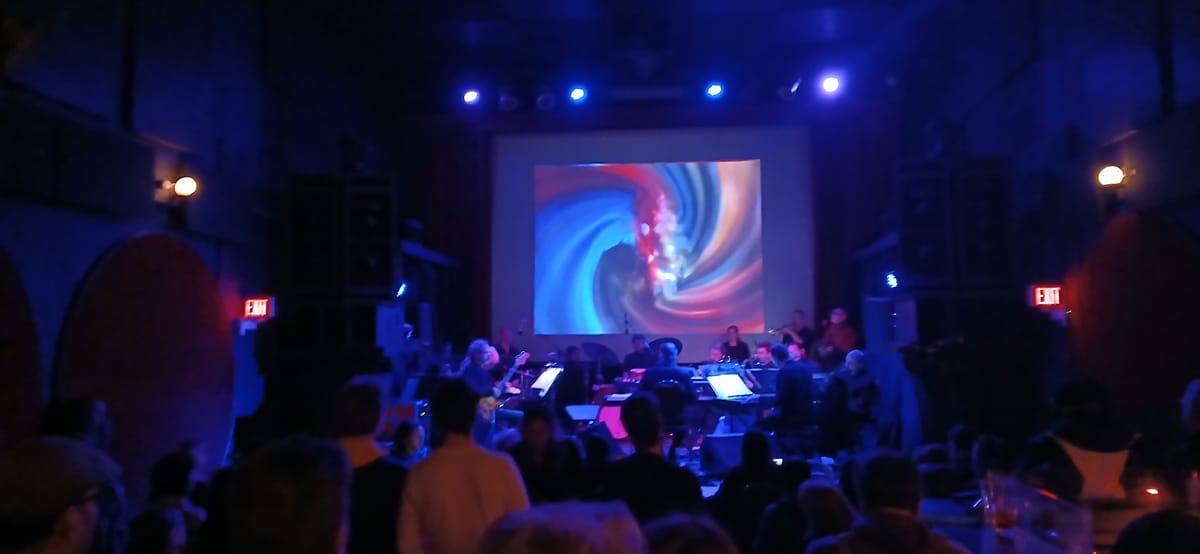
Hearing composer and trumpeter John Korsrud's large electroacoustic ensemble called Absolute Unit, as I did on Wednesday, January 21st at the Fox Cabaret, was like watching an action movie. They took us on a nonstop 90-minute expedition: drones, collective improv, bleeps and boops of droid-like noises, and R&B-soul gems.
The band has also been a balm for many of its members, including seven whom I reached by email or Instagram in just the 24 hours after the show. Absolute Unit gives them space to breathe and feel alive in that dangerous world. They used words like diverse, affirming, and freedom to sum up how they felt about what Korsrud facilitated.
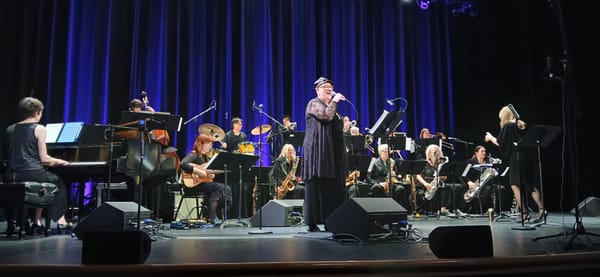
Some of the songs that materialized mid-set contributed to the vibe. Aretha Franklin's "Ain't No Way" is a blissful sunset after frantic improv; mashups of parts from Marvin Gaye's album What's Going On are the most recognizable snippets to cling to in the chaos. A visualizer projection runs throughout.
This week was my first time hearing the band, but they've played several times in recent years. The first time Absolute Unit appeared on the gig list was June 1st, 2022. They played a lower-key establishment than the Fox, one that hosted them again several times afterward: LanaLou's.
Saxophonist Ardeshir Pourkeramati was on that 2022 gig as well as this week's show. "The band is a bit more structured than it was back then," Pourkeramati said. "However, improvisation is still a thriving key concept within the repertoire and the musicians. While we have a setlist of pieces that we play, John directs us with open-ended improvised sections that bridged the compositions together, eliminating any breaks between the numbers."
John Nicholson was the other tenor saxophonist at the Fox. Nicholson described the night as "a collective flow state. Everyone was listening and working together effectively to create a continuous soundscape that never felt overwhelming or too flat."
Completing the sax section with them were Brent Mah on alto, who played at least one excellent solo that would've benefited from closer proximity to his mic; and Adam Kyle, who played baritone sax.
"Playing in the band," Kyle said, "I feel like once the show starts, I am transported to this liminal space that John has curated between improvisatory and pre-ordained. To go from ambient to funk to drum and bass to noise to 80s art-pop all in one set is insane."
In its three-plus years running, Absolute Unit has also played at Presentation House, the SFU Woodward's Atrium, and previously at the Fox, too. Korsrud uploaded a few clips like this one to his YouTube channel between these shows to give a general impression of the project.
I found the most striking characteristic of their lineup to be all the electronic artists: Aysha Dulong, Chris Kelly, Giorgio Magnanensi, Piu, and Stefan Smulovitz had tables of synths and boards which sprawled offstage, on the floor where the mosh pit would be.
"The acoustic instruments all have charts," Smulovitz said, "while the four, five of us on electronics have more of a general outline and freedom to add electronic spice as we feel inspired. Last night I was using a SOMA FLUX, which is an evolution of the theremin played by using two magnets." This theremin-like sound was one of a couple high-pitched elements that flew above thick rumblings and washes, catching your attention.
The second-most striking thing about Absolute Unit, which would be first in most bands, is having two drummers: Trent Otter and Eliot Doyle. Not only are they two of the most technically fearsome drummers in the city, but they both are easygoing, allowing them to float alongside each other and make sense of it all.
The sound of Doyle and Otter's two cymbals churning, or their two kick drums and two snares punching, was like an acoustic, human version of digitally expanding a drum part via effects. It was somewhat hypnotic. Rather than dominating the band, their interplay buoyed and widened the groove.
Otter said that the concept is "unlike any other [he's] ever experienced, and being a part of it has been eye-opening on what is possible sonically in a live format."
Korsrud and Jocelyn Waugh comprised the trumpet section and stood in the back corner; they brought colour more than lead-trumpet bombast. To give directions to the band, Korsrud sometimes leaned over the saxes and walked to Otter's drumset. They needed no conductor or cues beyond that.
The rhythm duo opposite Korsrud was Ron Samworth on guitar and André Lachance on electric bass. Lachance is the constant engine in the group, playing compressed notes both with a pick and fingerstyle.
Samworth played a couple guitar solos with effects and was a major melodic voice in the first half of the show. He said his favourite thing about Absolute Unit has been "the challenge of integrating so many diverse elements into a cohesive whole. The electronics add a whole different sound world and context to the otherwise fairly conventional instrumentation, and I think it's that contrast that makes it work, guiding the audience from familiar material to newer sonic terrain, and back again."
Two keyboardists sat downstage facing away from the audience: Dean Thiessen, who had an organ patch as part of his array, and Noah Franche-Nolan. They were loud in the mix in a helpful way – one of the only instrument groups other than bass that regularly came through as loud as the electronics.
A final distinctive feature to note about Absolute Unit, one that Korsrud has used in his other well-known groups, is the vocalist as ensemble member. I heard SJ Kirsch sing wordlessly in the improvs, then step forward with other wordless but recognizable moments, like the A minor section of "What's Going On" and the way-in-the-back high pitch from "Ain't No Way".
Kirsch said being in the band "felt emancipatory and affirming. As a recovering classical vocalist, it’s so nice to just be another instrument in the band. It’s also so nice to get to improvise with all these excellent players."
Kirsch has "the voice of an angel that sweeps us to other worlds," Smulovitz said. Their vocal feature of the night was the Nocturne from On this Island, a song cycle by English composer Benjamin Britten with words by the poet W.H. Auden. Franche-Nolan played the stately but sensitive chords.
"Getting to play the Britten/Auden tune was very special for me," Kirsch said. "The text and music are so cosmically beautiful and scathingly relevant." To speak to this relevance, they compared the time of the piece's composition in the 1930s to now, citing "a similar concentrated acceleration of the consequences of the hubris of totalitarian coloniocapitalists".
"It's a prayer for the unburdened sleep of a friend," Kirsch said.
Korsrud recorded audio and video of this full show with engineer Marc L'Esperance, so we'll likely see part of it on his YouTube channel or elsewhere soon. He already has more big shows announced for the spring.
A new large ensemble, Casual Sports Outfit, has unknown members but a confirmed Infidels Jazz show at the American on April 12th. Then, his Hard Rubber Orchestra will premiere works by Anna Webber, Matt Choboter, and Absolute Unit member Noah Franche-Nolan at the Fei and Milton Wong Theatre on May 23rd.
Jan. 23: I updated how I referred to the Benjamin Britten piece that they played.