The Coastal townhall: future of the festival & the board
Watching something that happened in our scene within the past week so you don't have to


I watched the online townhall hosted by Coastal Jazz on Sunday, October 30th.
Actually, I couldn't even attend. However, Coastal released a recording of the full 89-minute online townhall.
The townhall happened in advance of Coastal's Annual General Meeting of 2022, which will take place on Sunday, November 27th at 7:00pm.
In my conversations with friends around the scene, I often get asked, "Will there even be a festival next year?"
The burning question
Though this may be well-known information already, executive director Nina Horvath, said yes:
"At bare minimum, If we get absolutely no money in, we can still produce a festival this coming year. It would be shorter, it would be 5 days instead of 10 and have to cut back on some of the venues, but will still bring some of the things that we all love to the festival; and so we're planning under those expectations, with the possibility that, hopefully as we maybe get more money, we can expand those offerings."
If you had attended the townhall to learn about the festival's future, you'd have waited an hour-and-a-half for the above quote, delivered mere minutes before adjournment.
In her operations update, Nina also described the search for a title sponsor to replace TD:
"We are in the process of looking for a new title sponsor. We have engaged an external firm called Unite Partnerships to help with that. They've been on board since just right before the festival, this last June; so they did get to see the festival, they spent the summer going through a process of assessing and evaluating our organization, and now we're in the pitching stage and looking for new sponsors, both title and sort of a presenting partner level. So that process is ongoing."
The "presenting partner level" idea suggests that, even if Coastal gets a new title sponsor, they're expecting a lower amount of funds from that account and are already looking to get more sponsors involved to cover the gap.
The bulk of the meeting
Generally under 20 total people were present throughout the live meeting, including Coastal board and staff.
These were the four questions on the agenda, as written by Coastal in the meeting chat:
- Should board members be allowed to run for election again, after a break of a determined time, once they have served their maximum term? Or once you are a board member and have served your maximum term, should you no longer be allowed to run for election at any future date?
- What are the key criteria we want to establish to become a member of the society and how is this distinguished from donors?
- What are the different ways to carry out an election or appointment of board members at an AGM and what method would the society like to adopt?
- What are members' opinions on remuneration of board members?
The meeting broke up into groups to discuss each point.
Board members re-election
New board members Julia Ulehla and Steve Young, Kevin Wurmlinger, and staff artistic programmer Cole Schmidt discussed this topic. They suggested that each board member could have two three-year terms, with break of three years.
Barbara Kaminsky suggested that staggering a new board member's onramp with 1-year, 2-year, and then 3-year terms was a good idea. Nina, and Julia Ulehla, agreed.
On the other hand, new board member Meredith Bates said that for new board members, "A probation period seems a bit punitive". Michael Matich and Amélie Malissard emphasized that it's hard to get board members, even for big organizations.
Accessibility of being a member
Meredith, Karen Dar Woon, and Shora Parvaresh agreed that having "a fairly low annual membership fee to allow more people to vote" is important. Up to now, the most affordable listed donor tier has been $50.
Meredith also brought up "Allowing proxy voting or secure electronic voting" and the option to "make an in-kind donation, like 4 hours of volunteer work, to become a member" in her report back from her group's discussion.
Nominations and voting
New board member Parmela Attariwala, from her group with Coastal Foundation for the Performing Arts board member Lynn Buhler and Amélie, said that having candidates' information "sent out to the membership in advance, and to also have, potentially, advance voting" would help conduct elections in the organization.
The discussion on this point then moved to this question: will the board's directors have the ultimate control on who else is nominated for election as a board member, or will a nominating committee – which might still include some number of board members – assume some or all of that control?
Outgoing long-tenured board member Michael Matich asked: "How do you control some crazy person from getting on? The way it's written right now, the board decides who gets on and who doesn't ... if we take that language out of there, how do we control that?"
Nina wrote in the chat, "My understanding is that the nominations committee woudl [sic] still vet candidates before they go to the membership. So theoretically any candidate put forward for election would be well suited to serving on the board."
Discussion continued regarding what would happen if and when the board, or a nominating committee, rejects nominees.
Nonprofit governance consultant Alison Brewin, who is currently working with Coastal, said:
"If the proposed bylaws don't provide more names than people then the committee needs to explain that to everybody, why you chose not to do that [...] It's actually better for [Equity, Diversity, and Inclusion] to have, 'Here are the 5 people we want to join the board,' and that's it, because the majority [of members] could elect only white people, for example."
Alison's remarks imply that, if too many people get considered, tension could arise from who ends up getting nominated.
Paying board members
Generally, nonprofit board members don't – or can't – get paid.
Amélie asked, "Could 100% of the board members be musicians?"; Nina said, "The majority of the board members need to not be remunerated by the festival in any way."
Parmela said this about people who might bring in-demand skills and perspectives that match Coastal's executive priorities:
"A number of those kinds of peoples, particularly indigenous, are demanding that they be paid for their time, because they are a scarce resource ... that was part of why we brought up this question."
While the upcoming 2022 AGM shouldn't be as combative as last year's infamous event, questions of money, time, and priorities continue to swirl. Rainbow Robert was name-checked three times in this townhall, and Parmela included, in her introduction, a quote that she attributed to Alison: "A wound does not disappear, it leaves a scar."
Coastal have put out a call for new board members here.
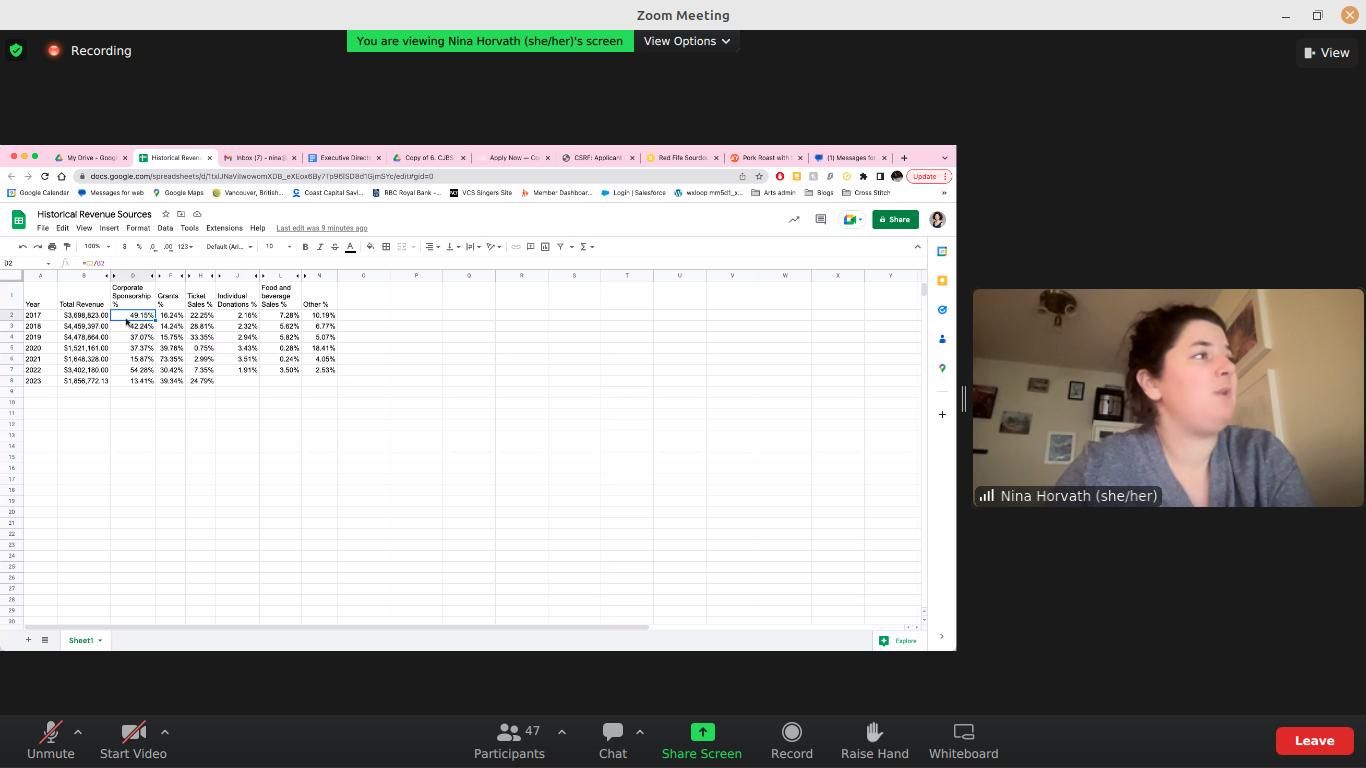
Update: I attended another townhall and found this intriguing screenshot. Maybe I'll tabulate these numbers later: