Sister Jazz Orchestra & Jennifer Scott play Joni Mitchell
This edition of SJO’s roughly annual show saw local arrangers take on Joni Mitchell’s Court and Spark, Blue, & more

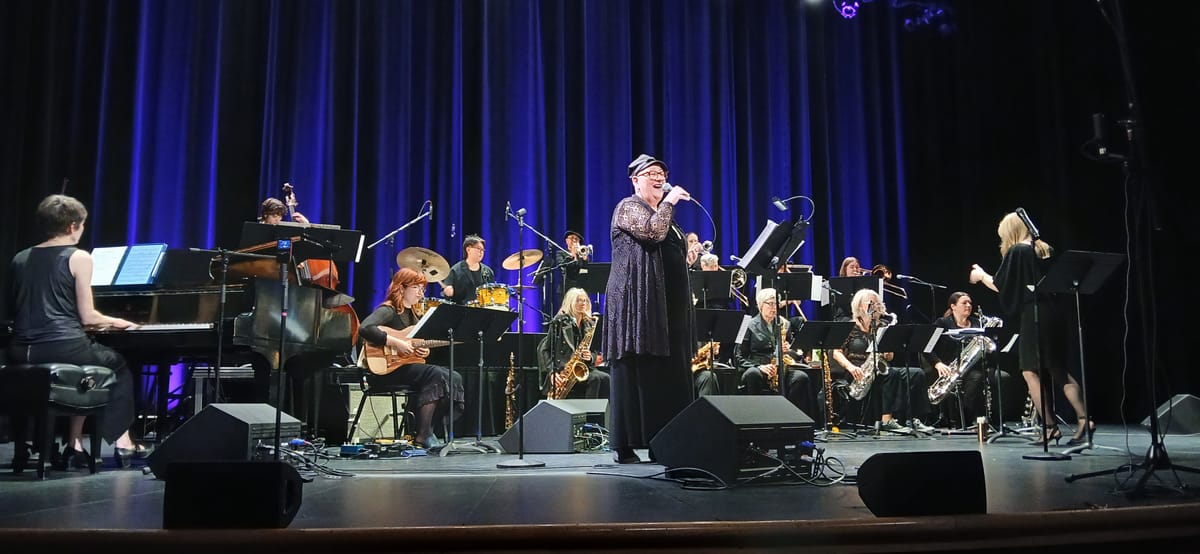
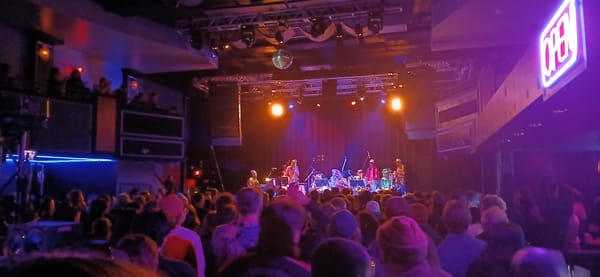
The Sister Jazz Orchestra (SJO) big band and featured vocalist Jennifer Scott played West Vancouver's Kay Meek Centre last Saturday, March 7th. The show, titled Joni Mitchell: Reawakened and Resonant, consisted of a dozen songs from Mitchell's discography. Ten of the numbers were arrangements by BC artists: Jill Townsend, Dean Thiessen and Cindy Dai-Thiessen, Andrew Homzy, and SJO director Christian Morrison.
I bought my ticket quite recently, but in late November, I noted that it's a marquee show for the Kay Meek. Four years ago around the 2022 edition of the show, Morrison joined me for one of my first-ever interviews. And in the earliest days of subscriber writing, I wrote to you about that show.
The band on Saturday was only two musicians different than SJO's website-listed lineup. Caley Honeywell, whose own website bills her as "Vancouver sax lady", was in on second tenor instead of Jen Davidson. And Bella Fedrigo, the group's youngest member, was on upright and electric bass.
I'd heard the two Thiessen arrangements before. At a Fox Cabaret show by the Stranger Friends Orchestra in 2024, the director Dean and vocalist Cindy performed Mitchell's "Help Me" and "Both Sides Now" with the band.
 Will Chernoff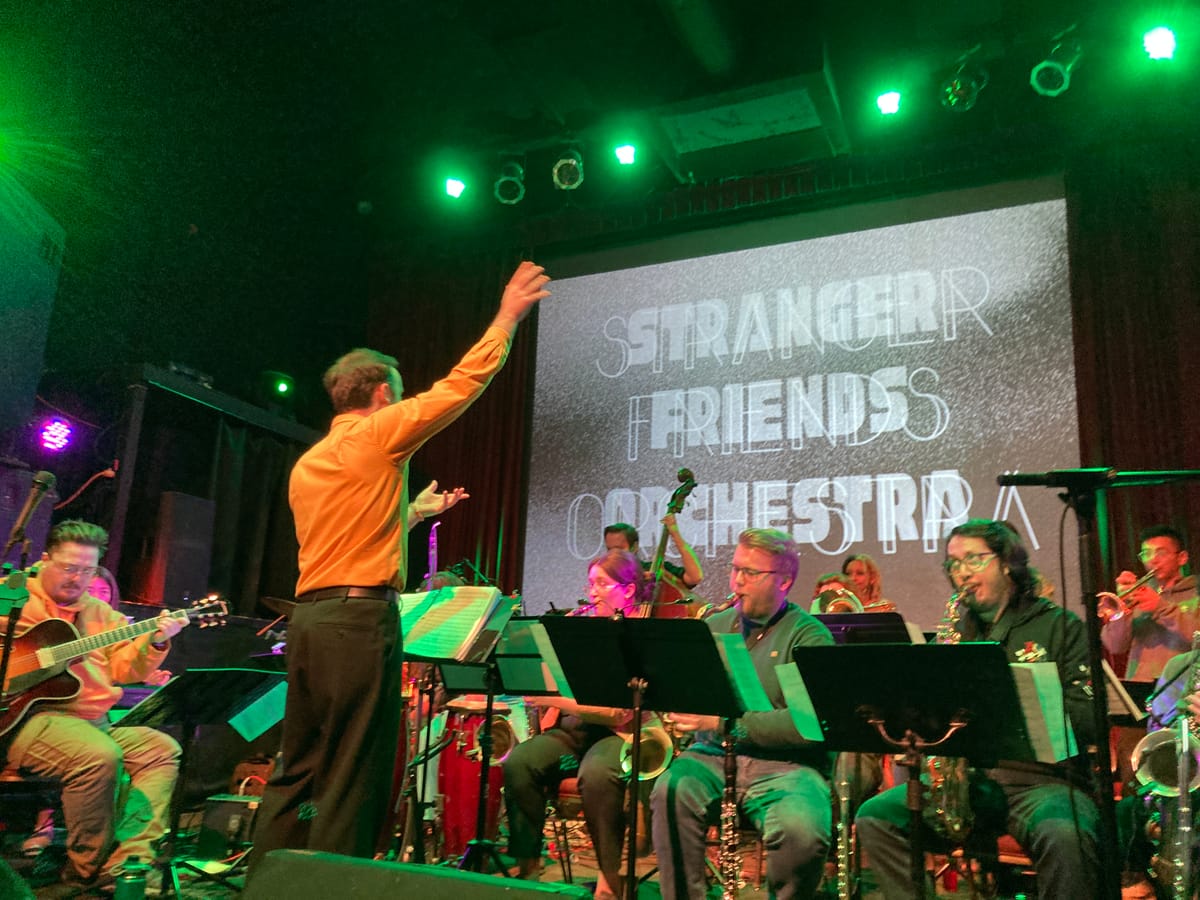
Here's what Dean said back then about "Help Me":
"'Help Me' was the arrangement I wrote for my final [project] for Bill Coon’s big band arranging course in 2016 at Capilano University. My arrangement is originally based on Tilden Webb’s arrangement, shown to me in 2015 by bassist Aaron Andrada."
As Dean references when he mentions "Tilden Webb's arrangement", "Help Me" is the opening track on the Jodi Proznick Quartet's Foundations, released 20 years ago in 2006.
This album was the first by Cellar Music to earn a Juno nomination. Its other tracks, like "RB's Line", carry the swinging force that made Proznick, Webb, and Jesse Cahill the house players at Cory Weeds' Cellar Jazz club. "Help Me", though, has a sensitive touch that mainstream jazz acts have sought for decades, especially when covering a 'pop' song. It'd sound fresh if released today.
The Proznick Quartet's instrumental version of "Help Me" is in a downtempo 3/4 time, while Mitchell's original recording from Court and Spark is a folk-rock arrangement in 4/4 time.
The Thiessen arrangement bridges the two moods, getting the words to move as briskly in three as the Mitchell original moves in four. That came through when I heard it sung by Cindy Dai-Thiessen just the same as when Jennifer Scott sang it with SJO.
Dean continued in my 2024 piece about "Both Sides Now", for which he rattled off a Maria Schneider-like sweeping treatment:
"'Both Sides Now' was Cindy's final [project] for the same class a year later. Both of the arrangements were only about a minute-and-a-half to two minutes long at first, so I had a lot of fun ripping them up, tearing them apart, and then putting them back together into the versions you heard at the show. These two pieces jumped out at Cindy and I as something really special eight years ago, and they felt like the perfect fit for this program too."
Across the rest of the show, the only chart that didn't come from a local arranger was the opening number, Tommy Banks' instrumental version of "Big Yellow Taxi".
With the exception of "Big Yellow Taxi" and a couple other moments of swing, SJO's style was typical of contemporary big bands: a patient expository approach, the instrumentalists' sections weaving atop one another, and the guitar and piano playing parts in unison with the horns just as often as they did their own thing in the rhythm section.
Morrison and Scott shared a lot of apparently scripted talk between tunes. They discussed the characteristics of Mitchell's songs and also shared the arrangers' personal notes about their inspiration for each number.
A majority of the setlist came from just two albums: 1971's Blue ("Little Green", "A Case of You", and the title track) and 1974's Court and Spark (the aforementioned "Help Me", "Free Man in Paris", "Raised on Robbery", and Annie Ross / Wardell Gray's "Twisted", the only non-Mitchell composition).
Mitchell's early song "Chelsea Morning", a love letter to the famous Chelsea Hotel, appeared in a complex arrangement that didn't at all match the sunny guitar-and-vocal on 1969's Clouds. On the other hand, "Be Cool" from 1982's Wild Things Run Fast sounded made-to-order for the ensemble.
SJO twice sent members offstage during more intimate numbers. To play the wide-open blues "The Dry Cleaner from Des Moines", Caley Honeywell and trombonist Hayley Bennett put down their instruments to sing backing vocals alongside Scott, and the band stripped down to a chordless format with only one or two of each horn plus electric bass and drums. Fedrigo was ready to handle the role of Jaco Pastorius. This song comes from Mitchell's 1979 album Mingus, but I think first of this live footage with Michael Brecker on tenor saxophone that I discovered in high school.
Then, Scott's solo performance at the piano of "Blue" struck me. Her musicianship is undeniable, and yet I've listened closely to that song so many times, any reharmonizations of its distinctive piano voicings feel unpalatable. The audience nevertheless delighted in the performance and gave her all the well-deserved applause.
"Blue" reminds me of my first time bandleading again after Early Spirit had started. In the spring of 2019, I put on a show at the Lynn Valley Legion. (Basically my only option; I'd lost touch with almost everyone around here.) I had guests joining my quartet, and one of them was a friend who sang that song with us. I've never had a chance to hear this friend perform again since. That's the Joni songbook: something Canadian for everyone to cherish, and something for multiple generations of Canadian musicians to gather around through the years.