When you're in the good times
how to grow a Western Red Cedar, or: everything we played at our festival show

"It's good to know you're in the good times when you're in the good times." That's roughly a phrase I heard and said during the festival this year. Turns out it resembles a quote from The Office: "I wish there was a way to know you're in the good old days before you've actually left them."
There is at least one way, and I'm decent at it. I performed a festival show two weeks ago with my current band called Western Red Cedar. The band is an attempt to weave together my whole musical life, but to date we've mainly played other people's music. And you see, I've known I was in the good times at many points through the years of discovering the music we performed two weeks ago. Similar to how I know I'm in them today.
That doesn't mean it's been easy, rather if not for this particular feeling, I would've given up a long time ago. But I haven't given up, and here's the representative story of all 14 pieces we played at the festival.
Before I ever made albums, interviewed people, or worked for music companies, I was taken in by the North Shore Celtic Ensemble after dropping out of Capilano University. The youth music program of violinists only found me because they'd just found a CapU-mate of mine, Kirin Lamb, in Scotland.
Day one of me playing bass with the Ensemble was January 11, 2014. The night before, I was blackout drunk to celebrate my 19th birthday. I woke up to my phone alarm on a friend's basement floor, walked home shivering across New Westminster from Park Row to the West End, got my upright bass and amp, walked immediately to the SkyTrain, and headed for Gilmore station.
Ensemble co-founder Jay Knutson (with Kirin, who'd be my fellow staff member there for several years, sitting shotgun) picked me up. We went to an Ensemble retreat, a twice-annual weekend of learning repertoire and building camaraderie. We kicked off that day's rehearsals with standard Irish tunes: a set of the jigs "The Kesh" and "Morrison's", then a set with "Cooley's Reel" and "Drowsy Maggie" (1/14).
Later that evening, I briefly met two fiddlers my own age who'd just finished their first semesters of post-secondary music. They were Ensemble star alumni, because few students in the program tried pursuing music professionally. (It's far too upper-middle-class for that.) They were back home to hang at the retreat's Saturday night jam. One was Tegan Wahlgren, the artist now known as Wallgrin; the other was Gabriel Dubreuil.
Gabriel and I wouldn't meet again until after all the stuff that led to my album Aim to Stay. While I was away in Denmark, an American duo called the Milk Carton Kids played the 2015 Edmonton Folk Music Festival and then played the Vogue in Vancouver on October 7th, 2015. I heard via Skype about how great these shows were and started listening to "Michigan" (2/14), the popular lead track of their second album Prologue. I still had a whole month left of my trip, but it made me look forward to coming home.
I returned from Denmark with no idea what to do. Then, suddenly, what so far has been the rest of my life snapped into place. In early 2016, I took a ferry to Victoria and happened to sit down across from my future spouse. Vez and I spent the whole day together before parting for our evening plans, then continued dating back in Vancouver.
I also played bass with Jay around BC, away from the Ensemble, sometimes joined by Tegan and other young fiddlers. Jay sang his own songs and arranged them with Ensemble tunes. Meanwhile, Gabriel moved back home after graduation. He wanted to self-record an album and use it to book performances around BC as well, so he called his former Ensemble director, Jay, to accompany him on guitar. (The other co-founding director is Claude Giguère. whom Gabriel later succeeded as the Ensemble's executive director.)
Jay brought me along. In late June of 2016, Gabriel, Jay, and I went to a cabin in Pender Harbour and recorded a debut album called Back to Back Bay. It's the final time to this day that I recorded on upright bass. One of the Ensemble tunes we filled the tracklist with was a waltz by the late mandolinist John McGann: "Canyon Moonrise" (3/14).
Mere weeks later, I went to Scotland with the Ensemble to perform. It was the Aberdeen International Youth Festival, a Big Oil-funded recurring summer event that brought together semi-professional groups like ours from around the world. I tried to be a sponge for fiddle tunes, writing down melodies as I was hearing them. One tune I learned in Aberdeen was Canadian, written by the late Oliver Schroer: "Blue Reel" (4/14).
Kirin, both inside and outside the Ensemble, continued to be a dear friend and an essential musical influence on me. She'd grown up in the Sunshine Coast's folk music education scene, contributing on flutes, whistles, piano, and vocals. I owe my start on acoustic guitar to Kirin. We formed a duo, me on guitar accompanying her, to stretch out musically beyond the Ensemble. I bought my first guitar with gig money from our first duo run; on that run itself, I borrowed her 12-string guitar that had six strings on it.
One of Kirin's longtime friends from the coast, pianist Emily Wood, had released her own demo EP before Gabriel released Back to Back Bay. Emily's EP is one of my personal cult classics of the music. There's a tune on the EP that I erroneously thought Emily wrote, before being corrected on-stage by Kirin after Western Red Cedar performed it at Tyrant Studios. I know it simply as "Pipetune" (5/14), my opener at every Cedar show.
A year later in summer 2017, Gabriel, Jay, and I added a drummer. Ben Kelly was also an Ensemble musician-alum, seven years older than me and Gabriel. Jay retired from co-directing the Ensemble to prioritize fronting the new band. We named it Early Spirit and played a run of fall shows, then planned a studio album project for the spring of 2018.
We hired Leonard Podolak, a Winnipeg banjoist and non-profit arts executive, to produce the album. For our studio session at Monarch, we prepared a mixture of Jay's songs and Gabriel's instrumentals. The opening tune of the session went on to be one of our workhorse gigging numbers. Gabriel wrote it in two parts, naming the swing-tempo part "Réel du Cocotier" (6/14) and giving the dance-beat part the first English RC name he could think of, "Radioactive Cat". The second half of the piece is what Western Red Cedar played at the festival this year.
In 2018, Gabriel and I devoted ourselves to launching Early Spirit. On most of our free days (I had an office job and he taught violin lessons), I went to his family home in North Vancouver at nine AM with my laptop, and we researched venues and applications all day. We shifted from pots of coffee to tall cans of beer, working til around five PM. He was the band's agent and I was its manager. I was quite infatuated and (literally) intoxicated with him and all this.
One of the reasons we hired Leonard as producer was that he'd just produced an album, Auprès du poêle, by a young group kind of like us: PEI's Ten Strings and a Goatskin. At the time my favourite track was "Duhk Duhk Goat", named in reference to Leonard's band, The Duhks. It opened with a slow Swedish tune, "Begåvningsmarsch från Funäsdalen" (7/14): gift march from Funäsdalen village.
I discovered two other bands in this period that changed my folk life. One of them, The East Pointers, is a story for another day; I didn't perform any of their music two weeks ago. The other was the Martin Hayes Quartet with The Blue Room, the most perfect album of Irish chamber-folk.
Featuring Hayes on violin, Liz Knowles on the Baroque viola d'amore, the irreplaceable nylon-string guitar of the late Dennis Cahill, and Doug Wieselman on bass clarinet, the Hayes Quartet became a lodestar for me right away. I played some Hayes repertoire with Kirin, and I obsessed over live performances of the Quartet, picking up tunes like "The Boy in the Gap" (8/14) and "The Orphan" (9/14).
Those were my salad days – 2016 to 2019, Early Spirit; me and Gabriel taking on the world in our early twenties, with Jay and Ben; in the car talking life and sports non-stop and therefore missing every highway exit; playing hundreds of shows, everything from rooms we should've known better than to play, to stages we had no business being on; fighting about taking French gigs versus English gigs; posting our collective daily coffee and beer consumption to Facebook with emoji tallies; grounding myself in something new that both contrasted my teenage exposure to jazz and confirmed that yes, I could get out in the world to try whatever I want, now.
Early Spirit ended for me in 2020. I then started Rhythm Changes and threw myself into this project, searching for that feeling again. I didn't take the pandemic years well (another story for another day) and racked up a five-figure personal debt, which I used the great fortune of my first label management gig to pay off.
I turned the corner in early 2023. The artist-founder I worked for, Dave Douglas, made a tour stop at Bimhuis Amsterdam in January, and I got to watch the show via the venue's livestreams. I found the Bimhuis cool and subscribed to the YouTube Channel. One stream a couple weeks later featured a young Scottish saxophonist, Matt Carmichael, and his quintet. From the opening tune of their show, I was in love: sensitive folk music played in my kind of instrumental ensemble. They transitioned, at almost seven minutes in, to a second tune with a bit more motion. I loved that one even more! They had my undivided attention.
But not long after that, the cracks started to show in my label work. I had to move from New Westminster to Coquitlam, and during that month or so in the spring, I learned how to coordinate an artist's self-managed tour – by neglecting it and experiencing everything that could go wrong.
Then an album arrived on my desk from a great drummer, Rudy Royston. Rudy had made one of my favourite albums from the label's catalogue and was back with that ensemble. In the liner notes of the new album, Rudy wrote, "This music is dedicated to my late brother Ritchie Royston and my late brother Ron Miles." I didn't expect to know Rudy's brother by blood, but Ron Miles... I wasn't familiar, and bang, yet again I added a favourite artist. Between Matt Carmichael and the trio of Miles, Bill Frisell, and Brian Blade, I discerned more clearly than ever what spoke to me in so-called jazz.
Things really fell apart in the summer of 2023. I botched the production of two albums and communicated poorly with the artists, because I was scared of how I messed up. Artists didn't get their merch in time for their tours, and the albums' release dates slid into the future away from press opportunities. Some important partners and colleagues insisted that I was unfit for the job and needed to go. Though I think the boss would've kept me if I locked in and committed to staying, I couldn't bear wading through the mess I made.
The label let me go in September in the lead-up to one of my own recording sessions, which I'd booked back in the early summer. Then a different light turned on: Tim Reinert invited me to play an easygoing, short-lived Infidels Jazz series at Chill X Studios (see our past stories covering the series). I brought musicians who had never played with me before, so I couldn't tell myself yeah, but those are my longtime close friends I love so much, no one else will accept me. I put together a band that matched Matt Carmichael's instrumentation: Erika Chow on tenor saxophone, Katie Stewart on fiddle, Jancis on piano, me on bass, and Jamison Ko on drums. Erika and Jancis were already playing the music of Wayne Shorter together; Katie and Jamison were playing in Madelyn Read's band. When it felt like the walls were closing in on my career, here were people unbothered by me and happy to share time on the scene.
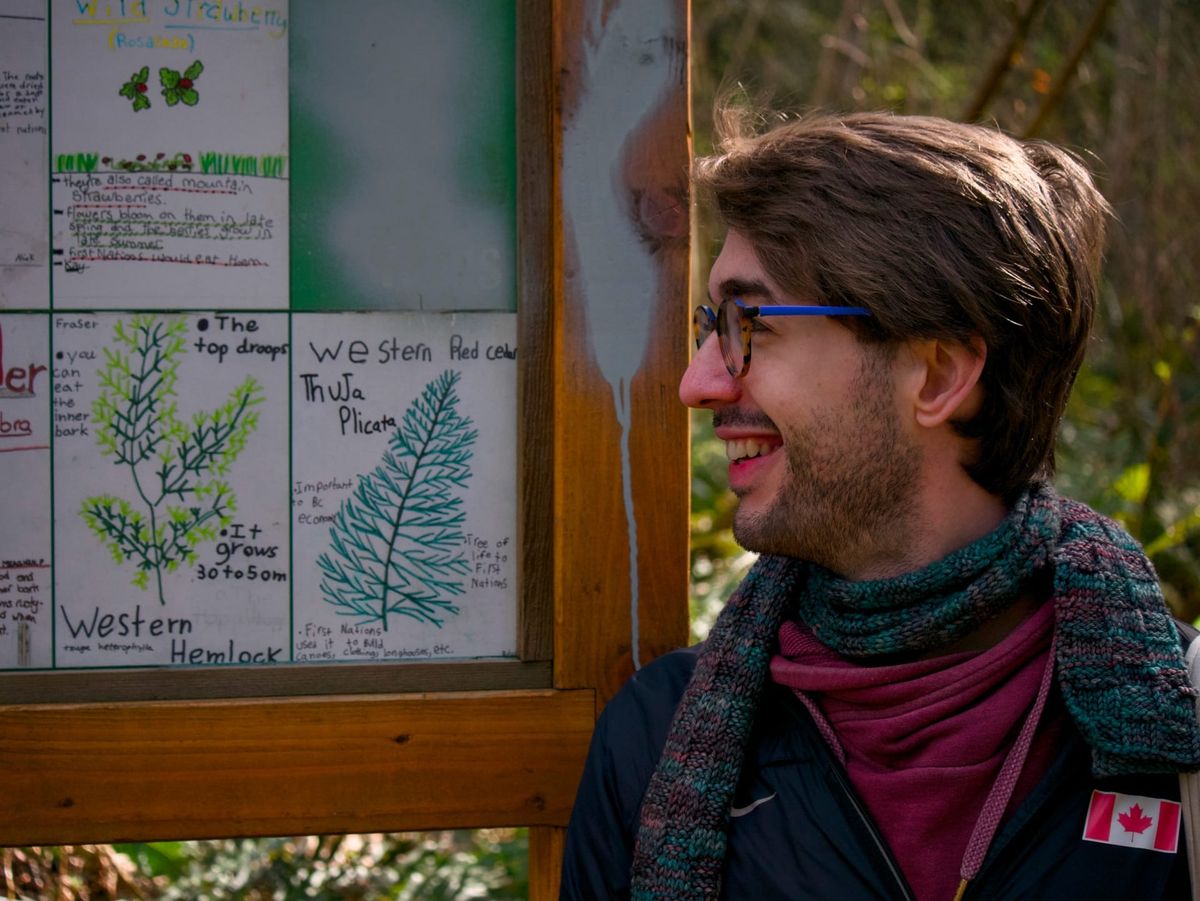
I needed to name this band. I thought about what could symbolize a west-coast mix of folk and improv. I considered what I wanted to call myself. That led me to the photo at the top of this article, where Vez and I were on a vacation that spring and noticed a school billboard with a drawing of thuja plicata, the western red cedar. The tree meant something to us because of my initials, WRC.
Western Red Cedar's debut show happened on November 8, 2023 at Chill X. After "Pipetune", we played that second tune from the Carmichael livestream. I didn't even know what it was called, so I put "untitled" on the chart. When Carmichael's album dancing with embers finally came out in March 2025, I learned the piece's title: "stone skimmer" (10/14).
I started to build up my client workload from the fallout of the label gig. Cory Weeds called as soon as it happened and hired me to do a couple things, letting me work my way deeper into the Cellar Music Group. I'm forever grateful for that.
I also joined a new group, the Madeleine Elkins Trio, alongside Kevin Romain. Being along for the ongoing journey of Madeleine leading this group has been a great joy and privilege. In terms of this story, I'll discuss Kevin, as he's the current drummer in my life following Carson Tworow and Ben Kelly. Learning to keep up with Kevin in a rhythm duo (let alone just hang with him, the cool guy as opposed to us four dweebs from Early Spirit; have you ever been so plainly the least cool member of a group of three?) has been great fun.
In the same month as Carmichael's album drop, March 2025, Kevin and I each led Infidels shows. I played the music of Ron Miles at the Lido, and Kevin played the music of drummer Ginger Baker (paired with a documentary screening) at the VIFF Centre. Between the two shows, Tim asked me if I'd heard the Ginger Baker album made in Denver, with local man Ron Miles as the musical director. I hadn't. When I searched it up, I couldn't look away from the odd choices and rickety beat of the title track, "Coward of the County" (11/14).
Western Red Cedar rotated through members and instruments. For a November 2025 show at Tyrant, Madeleine joined on electric guitar in place of the fiddle, and John Nicholson became the saxophonist. I started switching between acoustic guitar and electric bass. I leaned into a percussive guitar role on the quote-unquote Celtic tunes and held down those melodies. On bass, I chose to play two more Carmichael tunes from dancing with embers: "aglow" (12/14) and "flint" (13/14).
When Cole Schmidt and Jeremy Page offered me the Bentall stage show, I found Jancis wasn't available to play keys that day. Suin Park, another musician I'd never played with, subbed in and played wonderfully. Then finally, this spring, one more piece completed my festival setlist. Saxophonist Caroline Davis released her album Fallows with "Barbara Allen (for Geri)" (14/14), dedicated to the late Geri Allen.
Supposedly this was the same traditional song that the likes of Art Garfunkel sang, my former boss Dave Douglas recorded on Be Still, and Tony Wilson recorded on Denman Island. Yet they all sound different to me. That's a mystery, but Davis' version nevertheless drew me to cover it. Thus concludes our walk through what Western Red Cedar played at the Vancouver International Jazz Festival on June 26th, 2026.
So how do you know you're in the good times while you're still in them? Well, I'm not totally sure, but it seems like one way is to do what I apparently did through those years. You don't wait, hold back, or hesitate to go after what moves your heart. You don't say, "Someday I'll do X". The concept of a bucket list is meaningless because you're doing that stuff now, or at least you're aimed squarely at it. The result doesn't matter: the intent is true. You do work before you're qualified. You're willing to sacrifice comfort or security along the way, and you don't question whether or not it's worth it, especially if you can empower someone else you've met along the path.
That's right: you must go with people. Who they are will shift over the years – or maybe not, in the most special cases. These people also lean into things that move their heart, not the same as yours but complementary. When you meet each other in this feeling, it can look like many different things. Finding someone who also wants to fill their free time with whole nine-to-five workdays for uncertain returns. Writing to 100 readers and having one of them change your life when you're about to go broke. Going to every single one of a local artist's shows because you refuse to look back later and say I wish I'd gone to one more. Attending seven jazz festival shows in a day. I could go on, and I guess I just did.
In the bad times, I feel there's no time for having fun, only for grinding back from a deficit in hopes of maybe being adequate. The good stuff doesn't have to be productivity or accomplishments. The non-productivity view of throwing yourself into the world this way is that you aren't afraid to care. You can land in a scene of people who also care, not about the things you did but about you, because you too are trusted. What I wrote about today are times when, by the momentum of love plus interest, I escaped the default thought – I'm worth nothing and I need to accomplish more things or no one will like me – and made memories with people that transcend the drive for accomplishment.
By definition, it means you have no regrets. I'm very lucky to still feel like I'm doing it. My name is William Ross Chernoff and my musical project is Western Red Cedar. Playing (in the rain!) at the festival this year was a pleasure, and so was walking around and taking it in, sharing those times together. The tree I've grown will soon be taller than I ever dreamed: a new chapter will open.